
Search
Did you mean: Runes?
Remove Ads
Advertisement
Search Results

Definition
Writing - The Preservation of Human Thought and Action
Writing is the physical manifestation of a spoken language. It is thought that human beings developed language circa 35,000 BCE as evidenced by cave paintings from the period of the Cro-Magnon Man (circa 50,000-30,000 BCE) which appear to...

Definition
Leif Erikson
Leif Erikson (also spelled Leif Eriksson, Old Norse Leifr Eiríksson), nicknamed Leif 'the Lucky', was a Norse Viking who is best known for arguably being the first European to have set foot on North American soil along with his crew c. 1000...
Definition
Script - The Written Record of Humanity
Script is the written expression of a language. Cuneiform, the first script, was invented in Sumer, Mesopotamia, circa 3600/3500 BCE; hieroglyphics sometime prior to the Early Dynastic Period in Egypt (circa 3150-2613 BCE); and Sanskrit in...

Definition
Odin
Odin (Old Norse: Óðinn) is the main god in Norse mythology. Described as an immensely wise, one-eyed old man, Odin has by far the most varied characteristics of any of the gods and is not only the deity to call upon when war was being prepared...

Definition
Varangian Guard - Bodyguard of the Byzantine Emperors
The mercenary Varangian Guard was an elite Byzantine army corps and the personal bodyguard of emperors beginning with Basil II in c. 988 CE. The Viking unit was famous for the stature of its members and their blood-thirsty conduct in battle...

Definition
Sleipnir
Sleipnir is the eight-legged horse ridden primarily by the god Odin in Norse mythology. He is the son of the god Loki (in the form of a mare) and the stallion Svadilfari who belonged to the jötunn that built the walls of Asgard. In Iceland...

Definition
Baldr
Baldr is a god in Norse mythology associated with light, wisdom, and courage, although he is never specifically defined as the god of any of these. He is best known for his dramatic death, which heralds the coming of Ragnarök, the end of...

Definition
Gisela of France
Gisela of France was a legendary 10th-century CE Francian princess, who, according to tradition, was married off to Viking leader Rollo of Normandy. Her name, Gisela or Gisla, comes from an Old German word meaning "to pledge", the French...
Definition
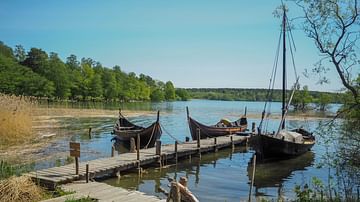
Birka
Birka, located on the island of Björkö in present-day Sweden, was an important trading center and strongly fortified town in the Viking Age which flourished from the 8th through the 10th centuries CE. Along with the town of Hedeby which is...

Article
Norse-Viking Symbols & Meanings
A symbol is an image or object which represents an abstract concept, often having to do with one's religious beliefs. Every civilization, from the most ancient to the present, has made use of symbols to make the abstract concrete and visible...
