
Search
Remove Ads
Advertisement
Search Results

Article
The Year of the Four Emperors & the Demise of Four Roman Legions
During the Year of the Four Emperors (69 CE), the fight between Vitellius and Vespasian would ultimately bring about the demise of four legions, the XV Primigenia, I Germanica, IIII Macedonica...
Article
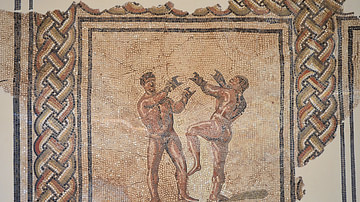
Boxing in the Roman Empire
Boxing is one of the oldest sports in the world that is still practiced today. Included in the original athletic contests of the Olympic Games, pugilism or boxing was well known and loved by the ancient Greeks and Romans...

Definition
Charles V, Holy Roman Emperor
Charles V, Holy Roman Emperor (24 February 1500 to 21 September 1558) reigned from 1519 until his abdication in 1556 and was one of the most powerful rulers in the history of the Habsburg dynasty. Through a series of...

Article
Roman Girls and Marriage in Ancient Rome
In ancient Rome, the legally acceptable age for marriage for girls was twelve. Although in middle-class Roman society, the most common age of first marriage for a girl was mid-to-late teens, evidence also shows...

Article
Battle of Telamon
Ever since the 4th century BCE, the Gallic tribes of northern Italy clashed with the expanding Roman Republic. In 225 BCE, the Boii forged alliances with fellow Gallic tribes of northern Italy and with tribes from across the...

Lesson Pack
Roman Warfare & Battles
We have prepared five lesson plans including classroom activities, assignments, homework, and keys as well as: - Multiple choice quiz questions in an excel format - Glossary of keywords and concepts in an excel format...

Article
Slavery in the Roman World
Slavery was an ever-present feature of the Roman world. Slaves served in households, agriculture, mines, the military, workshops, construction and many services. As many as 1 in 3 of the population in Italy or 1 in 5 across...
Article
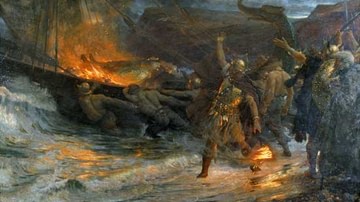
Norse Ghosts & Funerary Rites
In Norse belief, the soul of the deceased might wind up in any one of a number of afterlife realms. There was Valhalla, the realm of Odin where the dead warriors drank, fought, and told stories, Folkvangr ('the Field...

Article
Ancient Roman Society
Rome began as a small city on the banks of the Tiber River in Italy. The Latin tribes (also known as the Latini or Latians) inhabited the region c. 1000 BCE but the founding of the city is dated to 753 BCE. The family was...

Article
Officers of the Roman Army
With the appearance of the legionary, the Roman army was able to maintain a vast empire that totally embraced the Mediterranean Sea. Although the success of the army rested on the backs of the foot-soldiers and cavalry...
