
Search
Did you mean: Red-Figure Pottery?
Remove Ads
Advertisement
Search Results

Image
Red-Figure Stamnos Depicting Midas
An Attic red-figure stamnos depicting the satyr Silenus being led before the seated King Midas. c. 440 BCE attributed to the Midas painter. (British Museum, London).
Image
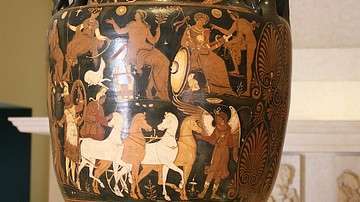
Red-Figure Volute Krater
A red-figure volute krater. 330 BCE, Tarentum. (Archaeological Museum of Taranto, Italy)

Article
The Red Handprints of Cozumel & Tulum
The Maya sites of San Gervasio (on the island of Cozumel) and Tulum (on the mainland of Mexico in Quintana Roo) are often overlooked for the better-known Chichen Itza or other spectacular ruins further inland...

Image
Etruscan Red-Figure Krater with Charun
The Etruscan death demon Charun escorts the deceased to the Underworld. He is characterised by a heavy hammer and a hooked nose. From Vulci (Italy). Around 300 BCE. (Altes Museum, Berlin)

Image
Red-Figure Toilette Scene
A red-figure kylix depicting two women in an intimate setting. The kneeling woman may be grooming the other woman or anointing her with oil or perfume. It has been suggested that the kylix may depict two women preparing...

Image
Red-Figure Satyr
The tondo of a red-figure kylix depicting a Satyr riding a donkey. c. 510 BCE. (Agora Museum, Athens)

Image
Red-Figure Owl Cup
A cup depicting an owl in the red-figure style. Attributed to the Marlay painter, third quarter 5th century BCE. (Archaeological Museum of Mykonos)

Image
Red-Figure Hydria Music Lesson
Close-up of a red-figure vase painting depicting a music lesson. In this section, two men play music while a boy and cat (alternately identified as a young panther) sit on the side. Attributed to "The Agrigento Painter"...
Image
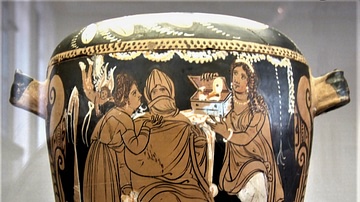
Red-Figure Vase Depicting Wedding Preparations
Red-figure vase depicting a bride being prepared for her wedding. Part the Adrano Group, 330-320 BCE. Sicily, Italy. Collection of the Pushkin Museum. (Image has been digitally altered for clarity)

Image
Attic Red-figure Kylix
Attic red-figure cup (kylix) depicting an athlete ready to throw the javelin, from Vulci (Italy), around 440/430 BCE.
(Altes Museum, Berlin).
