
Search
Remove Ads
Advertisement
Search Results

Image
Charioteer from the Red Faction
Roman mosaic depicting a charioteer and horse from the Red faction (factio russata), 3rd century CE. The charioteer wears a short decorated tunic in the colour of the stable, a leather helmet, and leather strips around...

Image
Lakota Chief Red Horse
Red Horse (l. 1822-1907), Miniconjou Lakota Sioux chief. Commercial cabinet card published by D. F. Barry (1854-1934). Red Horse's account of the Battle of the Little Bighorn and his accompanying ledger art are among the...

Image
Red Handprints, Tulum
Red handprints can be found on the walls of a number of Maya sites and are associated with the creator god Itzamna whose seven-fingered hands were red-hot to facilitate healing and who, naturally, became associated with doctors...

Article
The Eastern Trade Network of Ancient Rome
The life of wealthy Romans was filled with exotic luxuries such as cinnamon, myrrh, pepper, or silk acquired through long-distance international trade. Goods from the Far East arrived in Rome through two corridors...

Image
Moses & the Parting of the Red Sea
A 1907 CE Bible card depicting Moses and the parting of the Red Sea.

Image
Helios Red-Figure Vase
A red-figure kalyx-krater depicting the sun god Helios. The stars are represented by young male children descending into the ocean. Attica, c. 430 BCE. (British Museum, London)
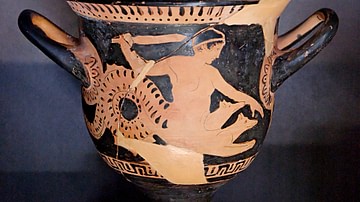
Image
Scylla, Red-Figure Vase
A red-figure vase depicting Scylla, the monster who preyed on victims going through the Straits of Messina. Boeotian, 450-425 BCE.
Louvre Museum, Paris.

Image
British Red Coat, 1767
An 1894 illustration showing the uniform of a Grenadier, 40th Foot regiment, 1767. The soldier is wearing his famous "red coat" made with cochineal dye. From R. H. Raymond Smythies (1894). Historical Records of the 40th...

Image
Red Dots Cluster, Chauvet Cave (Replica)
Replica seen in The Cavern of the cluster of red dots seen in Chauvet Cave. The art in Chauvet Cave has been dated to between c. 33,000-c.30,000 years old.
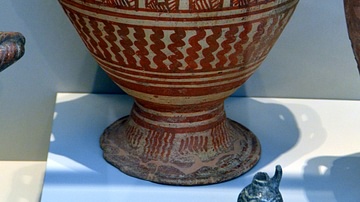
Image
Etruscan Red on White Pottery Vessel
An Etruscan red on white slip pottery vessel from Vulci or Bisencio, c. 700 BCE. (Antikensammlung Berlin)
