
Search
Did you mean: Ptolemy I?
Remove Ads
Advertisement
Search Results

Article
Astronomy in the Scientific Revolution
The astronomers of the Scientific Revolution rejected long-held theories of ancient thinkers like Claudius Ptolemy and Aristotle and instead set out to systematically observe the heavens in order to create a model of the universe that fit...

Definition
Apis
Apis was the most important and highly regarded bull deity of ancient Egypt. His original name in Egyptian was Api, Hapi, or Hep; Apis is the Greek name. He is not, however, associated with the god Hapi/Hep who was linked to the inundation...

Definition
Cleopatra Selene II
Cleopatra Selene II (40 - c. 5 BCE) was a member of the Ptolemaic Dynasty who became the queen of Mauretania upon her marriage to King Juba II of Numidia (48 BCE - 23 CE). Though more obscure than her famous mother, Cleopatra VII (69-30 BCE...

Definition
Cleopatra of Macedon
Cleopatra of Macedon (355/4-308 BCE), daughter of Philip II of Macedon (reign 359-336 BCE) and his Molossian queen, Olympias of Epirus (c. 375-316 BCE), was the only full sister of Alexander the Great (reign 336-323 BCE). Born in Pella, the...
Article
Alexandros I Balas
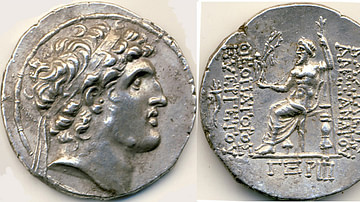
Alexandros I Balas was a Seleucid king from 152 BC to 145 BCE. As the Seleucid king Demetrius I Soter (162-150 BCE) became more and more unpopular due to his arrogance and drunkenness, it was quite an easy task for the rival kingdoms, such...

Definition
Alexander the Great
Alexander III of Macedon, better known as Alexander the Great (l. 21 July 356 BCE – 10 or 11 June 323 BCE, r. 336-323 BCE), was the son of King Philip II of Macedon (r. 359-336 BCE) who became king upon his father's death in 336 BCE and then...

Definition
Ergamenes
King Ergamenes (also known as King Arkamani I, r. 295-275 BCE) was the greatest king of the city of Meroe, Kingdom of Kush (located in modern-day Sudan) who broke free from Egyptian dominance to help direct a wholly distinct culture. The...

Article
The Battle of Actium: Birth of an Empire
The battle of Cynoscephalae in 197 BCE concluded the Second Macedonian War (200-197 BCE) and consolidated Rome's power in the Mediterranean, finally resulting in Greece becoming a province of Rome in 146 BCE. This engagement is sometimes...

Definition
Ancient Egyptian Government
The government of ancient Egypt was a theocratic monarchy as the king ruled by a mandate from the gods, initially was seen as an intermediary between human beings and the divine, and was supposed to represent the gods' will through the laws...

Article
Was Cleopatra Beautiful?
The idea that Cleopatra VII (69-30 BCE), the famous last queen of ancient Egypt, owed her powerful position to her beauty persists. “The nose of Cleopatra: if it had been shorter, the whole face of the earth would have changed,” the French...
