
Search
Remove Ads
Advertisement
Search Results
Definition
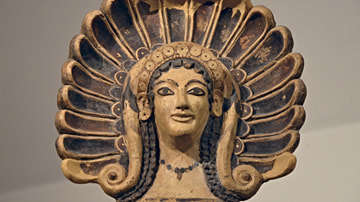
Etruscan Pottery
Etruscan pottery, produced over five centuries, was nothing if not varied. Indigenous wares such as the glossy black bucchero were made alongside red- and black-figure pottery imitating, yet modifying those produced in the Greek...

Definition
Bes
Bes is the ancient Egyptian god of childbirth, fertility, sexuality, humor, and war, but served primarily as a protector god of pregnant women and children. He is regularly depicted as a dwarf with large ears, long-haired and bearded, with...

Definition
Egyptian Medicine
Medical practice in ancient Egypt was so advanced that many of their observations, policies, and commonplace procedures would not be surpassed in the west for centuries after the fall of Rome and their practices would inform...

Definition
Hellenistic Period
The Hellenistic Period is a part of the Ancient Period for the European and Near Asian space. The use of this period is justified by the extent of the Hellenic culture in most of these areas, due to the Greek political presence...

Definition
Lucius Tarquinius Superbus
Lucius Tarquinius Superbus ('Tarquin the Proud') was traditionally the seventh and last king of ancient Rome before it became a republic. He belonged to the Etruscan Tarquinii clan, reigned from 534 to 510 BCE, and was...

Definition
Spartacus
Throughout history - both ancient and modern - those bound in chains have fought to free themselves from their oppressors. As with most civilizations - Assyrian, Greek and even American - slaves in ancient Rome were not considered...

Definition
Tlahuizcalpantecuhtli
Tlahuizcalpantecuhtli, 'Dawn Lord,' was a Mesoamerican god who represented a menacing aspect of Venus, the morning star, and was one of the four gods which held up the sky. The people of the ancient Americas believed his rays...

Definition
Giza
Giza is a plateau southwest of modern Cairo which served as the necropolis for the royalty of the Old Kingdom of Egypt. Most famous for the pyramids of Khufu (completed c. 2560 BCE) Khafre (c. 2530 BCE) and Menkaure (c. 2510 BCE) and the...

Definition
Viriathus
Viriathus (c. 180-140 BCE) was the leader of the Lusitani in their war with Rome. In 150 Viriathus escaped the Roman massacre and enslavement of Lusitani who had surrendered peacefully. Viriathus continued to fight in the resistance...

Definition
Byzantine Empire
The Byzantine Empire existed from 330 to 1453. It is often called the Eastern Roman Empire or simply Byzantium. The Byzantine capital was founded at Constantinople by Constantine I (r. 306-337). The Byzantine Empire varied in...
