
Search
Did you mean: Science?
Remove Ads
Advertisement
Search Results

Definition
Mythology
Myths are a part of every culture in the world and are used to explain natural phenomena, where a people came from and how their civilization developed, and why things happen as they do. At their most basic level, myths comfort by...

Definition
Kievan Rus
Kievan Rus (862-1242) was a medieval political federation located in modern-day Belarus, Ukraine, and part of Russia (the latter named for the Rus, a Scandinavian people). The name Kievan Rus is a modern-day (19th century) designation...

Definition
Vinland
Vinland (Old Norse Vínland, 'Wine Land') is the name given to the lands explored and briefly settled by Norse Vikings in North America around 1000 CE, particularly referring to Newfoundland, where a Viking site known as L'Anse aux Meadows...
Definition
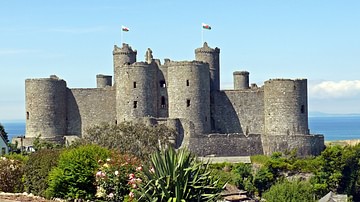
Harlech Castle
Harlech Castle, located in North Wales, was first built by Edward I of England (r. 1272-1307 CE) from 1283 CE. Largely completed by 1290 CE, the castle received some further additions up to 1330 CE. A classic example of a concentric...

Definition
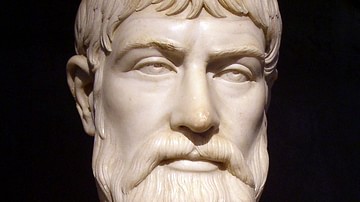
Despotate of the Morea
The Despotate of the Morea was a semi-autonomous appanage of the later Byzantine Empire. The Byzantines retook part of the Peloponnese in Southern Greece in 1262 CE, but the Morea was only officially governed by semi-autonomous...
Definition
Pindar
Pindar (c. 518 to c. 448/7 BCE) was an ancient Greek lyric poet, probably the greatest of his time. His works have been divided into 17 books of different types of poetry, but only those containing 44 choral victory songs composed for...

Definition
Franz Liszt
Franz Liszt (1811-1886) was a Hungarian composer of Romantic Music. Liszt first gained international fame as a piano virtuoso, an activity in which he was a pioneer, and then as a composer of piano works and symphonic poems, a form...

Definition
Thomas Hobbes
Thomas Hobbes (1588-1679) was an English philosopher who famously summarised his pessimistic view of human nature in his greatest work, Leviathan, published in 1651. Hobbes believed that the life of humanity in the state of nature...

Definition
Ancient China
Ancient China produced what has become the oldest extant culture in the world. The name 'China' comes from the Sanskrit Cina (derived from the name of the Chinese Qin Dynasty, pronounced 'Chin') which was translated as 'Cin' by...

Definition
Hamilcar Barca
Hamilcar Barca (c. 285 – c. 228 BCE) was a Carthaginian general active in the First Punic War (264-241 BCE). He then quashed a rebellion closer to home between 241 and 237 BCE before returning abroad, where he successfully expanded...
