
Search
Remove Ads
Advertisement
Search Results
Definition
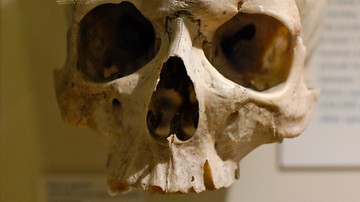
Homo Sapiens
Homo sapiens ('wise man'), or modern humans, are the only species of human still around today. Despite having invented countless ways of labelling the world around us, we have so far done a surprisingly poor job at defining ourselves...

Definition
Oldowan Tools
The appearance of simple stone tools, widely known as Oldowan tools or the Oldowan industry, marked the beginning of our technological revolution. To our knowledge, these artifacts appeared around 2.6 million years ago in the savannahs...
Definition
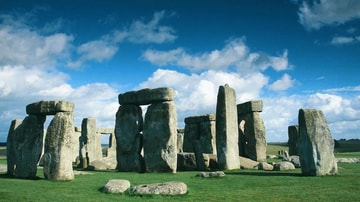
Stonehenge
Stonehenge is a Neolithic / Bronze Age monument located on Salisbury Plain, Wiltshire, southern England. The first monument on the site, began around 3100 BCE, was a circular 'henge' earthwork about 360 feet (110 metres) in diameter...

Definition
Long Barrow
A long barrow is a class of Middle Neolithic (approximately 3500-2700 BCE) burial monument which is found extensively throughout the British Isles and is related to other forms of contemporary tomb-building traditions of north-western...
Definition
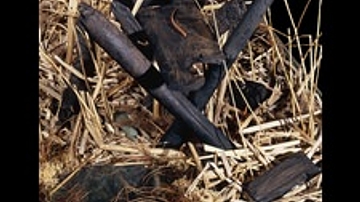
The Sweet Track
The Sweet Track is a Neolithic timber walkway, located in the Somerset Levels, England. It was originally part of a network of tracks built to provide a dry path across the marshy ground. The Sweet Track ran between what was then...
Image
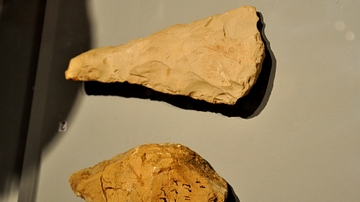
Hand Axe and Stone Tool
These were found in Barda Balka and are considered the oldest human-made artifacts among the whole museum's collections. Circa 100,000 BCE, from Barda Balka (near modern Chamchamal, Sulaimaniya Governorate, Iraq). (The Sulaimaniya...

Image
Human Skull Plaster Face, Ain Ghazal
This plastered face was modeled on a human skull and was buried with a group of similar plastered faces. This mode of skull decoration was probably related to some sort of ancestor cult. From modern-day Ain Ghazal...
Image
Plastered Face of a Human Skull from Ain Ghazal
This plastered face was modeled on a human skull and was buried with a group of similar plastered faces. This mode of skull decoration was probably related to some sort of ancestor cult. From modern-day...

Image
Plaster Face, Ain Ghazal
This plastered face was modeled on a human skull and was buried with a group of similar plastered faces. This mode of skull decoration was probably related to some sort of ancestor cult. From modern-day Ain Ghazal, outskirts...

Image
Stone Calf from Late Uruk Era
There is a hole on the back of this stone calf for vertical posts or other attachments. Late Uruk period, 3300-3000 BCE, from Ur, Mesopotamia, Iraq. (The British Museum).
