
Search
Search Results

Definition
Empedocles
Empedocles (l. c. 484-424 BCE) was a Greek philosopher and mystic whose work harmonized the philosophies of Parmenides (l. c. 485 BCE), Heraclitus (l. c. 500 BCE), and Pythagoras (l. c. 571 to c. 497 BCE) in presenting a unified vision of...

Definition
Philosophy
The word philosophy comes from the Greek philo (love) and sophia (wisdom) and so is literally defined as “the love of wisdom”. More broadly understood, it is the study of the most basic and profound matters of human existence. Philosophical...
Article
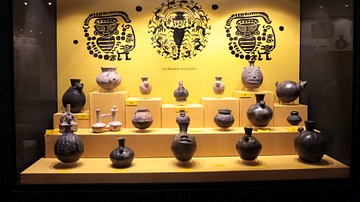
Pre-Inca Civilisations at the Tucume Museum
On 1 November 2015 CE, at the annual dinner hosted by the British Guild of Travel Writers at the Savoy Hotel in London, it was announced that the Tucume Museum in northern Peru had won the prestigious award for the Best Wider World Tourism...

Definition
Thales of Miletus
Thales of Miletus (l. c. 585 BCE) is regarded as the first Western philosopher and mathematician. He was born and lived in Miletus, a Greek colony in Ionia (modern Turkey) referenced as the birthplace of Greek Philosophy because of his high...

Definition
Democritus
Democritus (l. c. 460 - c. 370 BCE) was a Greek philosopher and younger contemporary of Socrates, born in Abdera (though other sources cite Miletus) who, with his teacher Leucippus (l. 5th century BCE), was the first to propose an atomic...

Article
The Three Estates of Pre-Revolutionary France
Society in the Kingdom of France in the period of the Ancien Regime was broken up into three separate estates, or social classes: the clergy, the nobility, and the commoners. These classes and their accompanying power dynamics, originating...

Article
The Pre-WWI Alliance System - Triple Entente v. Triple Alliance
The alliance system in Europe was one of the causes of the First World War (1914-18), although it did not make war inevitable. In the first decade of the 20th century, the Triple Entente powers of Great Britain, France, and Russia stood against...

Definition
Philolaus
Philolaus (l. c. 470 to c. 385 BCE) was a Pythagorean philosopher who claimed that fire was the first cause of existence and heat the underlying source of human life. He is best known for his pyrocentric model of the universe, which replaced...

Article
Heraclitus: Life Is Flux
Heraclitus of Ephesus (l. c. 500 BCE) famously claimed that “life is flux” and, although he seems to have thought this observation would be clear to all, people have continued to resist change from his time to the present day. Heraclitus...

Definition
Pythagoras
Pythagoras (l.c. 571 to c. 497 BCE) was a Greek philosopher whose teachings emphasized the immortality and transmigration of the soul (reincarnation), virtuous, humane behavior toward all living things, and the concept of "number" as truth...
