
Search
Did you mean: Postumus?
Remove Ads
Advertisement
Search Results

Article
Legions of Mesopotamia, Cappadocia, & Arabia
As the Roman Empire expanded further eastward, annexing territories that were once the domain of the Parthians, the legions of Mesopotamia, Cappadocia, and Arabia were called upon to safeguard these newly...

Image
Map of the Bosporan Kingdom, c.100 CE - Gateway Between Steppe, Caucasus, and Rome
The Bosporan Kingdom (c. 480 BCE–341 CE) emerged around the Cimmerian Bosporus (modern Kerch Strait) as a hybrid Greco-local state founded by Greek colonists from cities such...

Image
Cities Founded or Renamed in Hadrian’s Name (117 -138 CE)
During the reign of Emperor Hadrian (reigned 117–138 CE), urban patronage became a central tool of imperial governance and representation. Unlike his predecessor Trajan, whose rule emphasized territorial...
Image
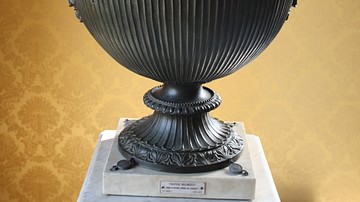
Crater of Mithridates Eupator
The bronze vessel known as the Crater of Mithridates Eupator. Found in Nero's villa, Rome. The inscription on the vase records the name Mithridates VI, king of Pontus (163-120 BCE). The vase was taken to Rome as war...
Image
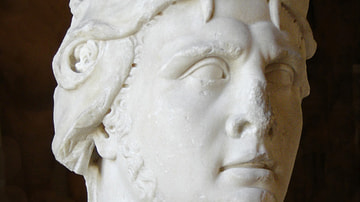
Mithridates VI
Mithridates VI ruled Pontus and Armenia minor 120-63 BCE. Here, he is depicted as Heracles wearing the skin of the Nemean Lion. (Louvre Museum, Paris)
Image
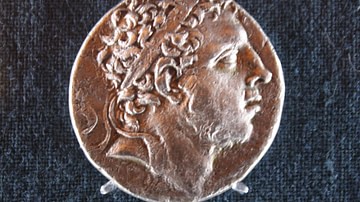
Mithridates V
Mithridates V Euergetes (r. 150-120 BCE), silver tetradrachm, Pontus. (Numismatics Museum, Athens)
Image
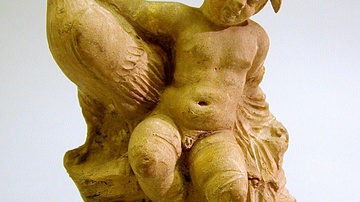
Terracotta Statue of a Boy & His Rooster
A Hellenistic statuette of a little boy with a pet rooster or game-cock. Roosters were common pets in ancient Greece, often given to children as playmates, or given to lovers as tokens of affection. Terracotta...

Image
Mithridates Silver Tetradrachm
Silver tetradrachm from Pontus, reign of Mithridates VI Eupator, 120-63 BCE. O: Head of Mithridates. R: Stag.
Image
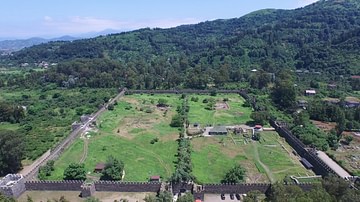
Aerial view of the Roman Fort of Apsarus
Aerial view of the Roman fort Apsarus, located in western Georgia, 15 kilometres (9.3 mi) south of Batumi near the Turkish border. Established on the left bank of the mouth of the Chorokhi River in the 1st...
Image
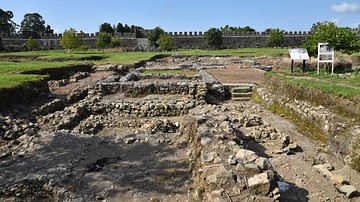
Remains of the Apsarus Roman Fort
Remains of the commanding officer's residence at the Roman fort of Apsarus in modern-day Georgia. The fort (known today as the Gonio Fortress) is located 15 kilometres (9.3 mi) south of Batumi near the Turkish border...
