
Search
Did you mean: Psyche?
Remove Ads
Advertisement
Search Results

Definition
Samoset
Samoset (l. c. 1590-1653, also given as Somerset) was the Abenaki Native American who first approached the English settlers of Plymouth Colony (later known as pilgrims) in friendship, introducing them to natives Squanto (l. c. 1585-1622...

Definition
Decebalus
Decebalus (c. 87-106 CE) was the king of Dacia (roughly modern-day Romania and Moldova) who fought two wars with Rome under Trajan (in 101-102 CE and 105-106 CE) in defense of his kingdom. Trajan (r. 98-117 CE) was renewing a conflict...

Definition
Yazdegerd III
Yazdegerd III (r. 632-651) was the last monarch of the Sassanian Empire (224-651), ruling – or attempting to rule – amidst the chaos of its final decline and fall to the invading Muslim Arabs. He was the son of the prince Shahriyar...

Definition
Nicias - The Athenian General
Nicias, or Nikias (c. 470-413 BCE), was a wealthy Athenian politician and general during the Peloponnesian War (431-404 BCE). He became established as a prominent political leader of the aristocratic faction in Athenian...

Definition
Washita Massacre
The Washita Massacre (Battle of Washita River) was the slaughter of the village of the Southern Cheyenne Chief Black Kettle (l. c. 1803-1868) and the peace chiefs aligned with him on 27 November 1868 at the hands of the 7th Cavalry...

Definition
Seven Years' War - The 18th-Century World War
The Seven Years' War (1756-1763) was a global conflict fought between the great powers of Europe in the mid-18th century. The culmination of several decades of conflict, it was caused both by colonial rivalries...
Article
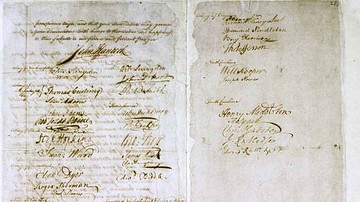
Olive Branch Petition
The Olive Branch Petition was a letter adopted by the Second Continental Congress on 5 July 1775 and sent to King George III of Great Britain (r. 1760-1820) in a final attempt at reconciliation in the early months of the American...

Article
Woodrow Wilson's Fourteen Points - A Plan for World Peace
The Fourteen Point Peace Programme of US President Woodrow Wilson (1856-1924) was presented to Congress on 8 January 1918 and outlined a new world order that would hopefully avoid another disaster...

Article
Mavia's Revolt & the Christian Question
In 378 CE the Tanukhid queen Mavia (r. c. 375 - c. 425 CE) of the Saracens led a successful revolt against the Roman Empire, pitting her forces against the armies under the emperor Valens (364-378 CE). Launching...

Article
Montpellier during the French Reformation
At the dawn of the French Wars of Religion (1562-1598), Montpellier in southern France had a significant Protestant minority that controlled the city's institutions. The Edict of Nantes in 1598 ended the wars...
