
Search
Remove Ads
Advertisement
Search Results
Image
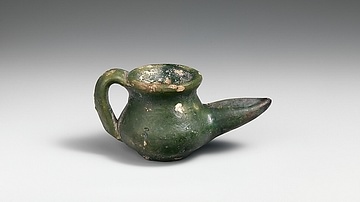
Crusader Lamp
Dating to the mid-13th century CE, this lamp was found near Acre, in present-day Israel. It measures 5.4 cm x 11 cm x 6 cm. (Metropolitan Museum, New York)
Image
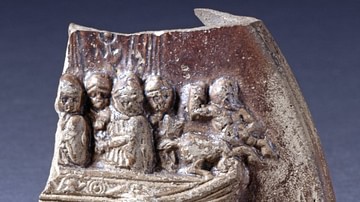
Roman Lamp Handle Ornament
Handle ornament broken from a terracotta lamp. It may commemorate Octavian's victory over Mark Antony and Cleopatra VII of Egypt at the Battle of Actium in 31 BCE. Possibly Italian, more probably Egyptian, fabric.
Image
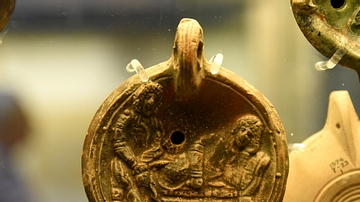
Lamp Showing Two Tragic Actors
The scene on this terracotta lamp depicts two tragic actors (perhaps Orestes and Pylades) on a couch; a severed head lies below. Roman period, made in Italy, about 175-225 CE. Transferred from the Wellcome Collection. (The British Museum...
Image
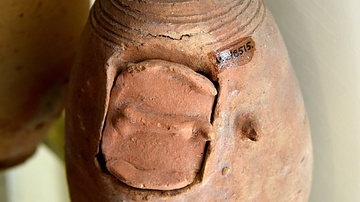
Lamp From Diopolis Parva
This is a redware pottery lamp which was done in the form of a granary with a separate door. It has a red slip on the door and around. From Diopolis Parva, Egypt. 2nd Intermediate Period, 1650-1550 BCE. The Petrie Museum of Egyptian Archaeology...
Image
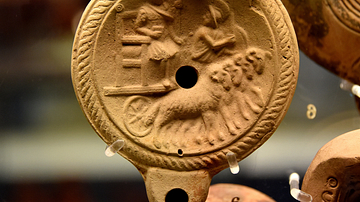
Lamp Showing Attis and a Corybant
The scene on this terracotta lamp depicts Attis on a cult-car pulled by rams; a Corybant (a devotee of the god) is shown beyond. Said to be from Mitcham, Surrey. Roman period, made in central Italy, about 175-225 CE. (The British Museum...
Image
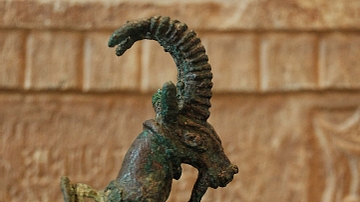
Arabian Ibex Lamp Handle
Lamp handle made of bronze in the shape of an ibex. 1st century BCE to 1st century CE. Southern Arabia. Louvre Museum, Paris.

Image
Nabataean Lamp from Wadi Musa
This is a pottery lamp. Nabataean Period, 100 BCE to 500 CE. From modern-day Wadi Musa, Jordan Hashemite Kingdom. (The Jordan Museum, Amman, Jordan).

Article
Colour & Technique in Renaissance Painting
There were three principal painting techniques during the Renaissance: fresco, tempera, and oils. In all of these techniques, colour was an important part of the painter's armoury, allowing them to create images that would strike a chord...

Definition
Cyrenaics
The Cyrenaics were a philosophical school of thought founded c. 4th century BCE by Aristippus of Cyrene (l. c. 435-356 BCE) who taught that sensual pleasure was the highest good and only worthwhile pursuit in life. Known as the first hedonistic...
Lesson Pack
Economy & Trade in Ancient Greece
We have prepared five lesson plans including classroom activities, assignments, homework, and keys as well as: - Multiple choice quiz questions in an excel format - Glossary of keywords and concepts in an excel format - Open questions...
