
Search
Remove Ads
Advertisement
Search Results

Definition
Lancaster Bomber
The Avro 683 Lancaster bomber was a four-engine heavy bomber flown by the Royal Air Force and allies during the Second World War (1939-45). Lancasters were particularly used in nighttime bombing raids and could carry the heaviest bombs ever...

Definition
Martin Bucer
Martin Bucer (l. 1491-1551) was a German reformer and theologian who had been a Dominican friar and priest until converted to the Protestant vision by Martin Luther (l. 1483-1546) c. 1518. Bucer is best known for his focus on unity among...

Image
Monte Cassino in the 15th Century
Illustration of Monte Cassino in the 15th-century Nuremberg Chronicle. Published in Nuremberg, Germany, 1493.
Image
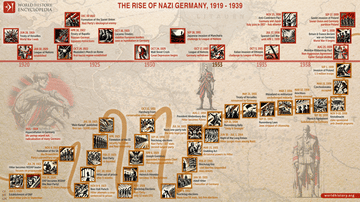
The Rise of Nazi Germany, 1919 - 1939
This infographic illustrates the rise of Nazi Germany in the aftermath of the First World War (1914-18), when the Treaty of Versailles (1919) imposed harsh reparations and territorial losses on Germany, leading to widespread economic hardship...

Article
What Were the Consequences of WWII?
The consequences of the Second World War (1939-45) were many and varied. Nazi Germany, Fascist Italy, and military-dominated Japan were all defeated. Many occupied countries were liberated and regained their freedom while others were obliged...

Article
Battle of Stalingrad - The Destruction of Germany's Sixth Army
The Battle of Stalingrad (now Volgograd, July 1942 to February 1943) was an attempt by Adolf Hitler (1889-1945) to control the USSR's access to the Caucasus oil fields. Fierce street-fighting by the Soviet Red Army saw the city withstand...

Article
The Invasion of Poland in 1939
The leader of Nazi Germany Adolf Hitler (1889-1945) ordered the invasion of Poland on 1 September 1939. Hitler's refusal to withdraw brought a declaration of war from Britain and France on 3 September, and so began the Second World War (1939-45...

Article
Allied Bombing of Germany
The Allied strategic bombing of Germany during World War II (1939-45) involved British and U.S. bomber planes attacking industrial cities, factories, railways, airfields, and dams. Over 600,000 civilians died as a consequence. The campaign...

Article
The Hindenburg Disaster - End of the Transatlantic Airships
The Hindenburg disaster occurred on 6 May 1937 when the German Zeppelin airship LZ 129 Hindenburg attempted to land at Lakehurst, New Jersey, but burst into flames. The airship's gas cells were filled with highly flammable hydrogen gas, and...

Article
Hitler's Occupation of Czechoslovakia
Throughout 1938, Adolf Hitler (1889-1945), the leader of Nazi Germany, threatened to occupy the Sudetenland region of Czechoslovakia. The excuse presented was that Sudeten Germans were being repressed but Hitler was intent on creating a 'Greater...
