
Search
Remove Ads
Advertisement
Search Results
Image
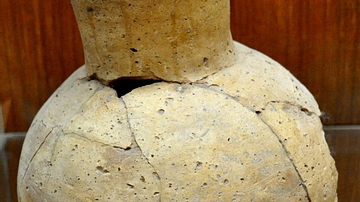
A Jar from Hassuna Culture
This ball-body jar was found in the Faida district of the modern city of Musil, Ninawa Governorate, Iraq. It dates back to the Hassuna period, 6th millennium BCE. (The Sulaimaniya Museum, Iraq).
Image
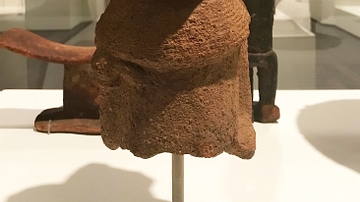
Nok Culture Fragment of a Figure
As a result of erosion and mining, one of the oldest and most sophistcated art-producing cultures known in sub-Saharan Africa came to light in the mid-20th century. Hundreds of hollow figures, heads, and fragments made of coarse clay have...

Definition
Etowah Mounds
Etowah Mounds (also known as Etowah Indian Mounds) is a National Historic Landmark and archaeological site near Cartersville, Georgia, USA, enclosing the ruins of a prehistoric Native American city whose original name is unknown. The present...

Image
Trialeti Culture Necklace
This golden necklace was made by people who belonged to the ancient Trialeti culture. They flourished during the late-3rd and early-2nd millennium BCE. Many exquisite items crafted in gold and silver by the Trialeti culture have been found...

Definition
Etruscan Civilization
The Etruscan civilization flourished in central Italy between the 8th and 3rd century BCE. The culture was renowned in antiquity for its rich mineral resources and as a major Mediterranean trading power. Much of its culture and even history...
Image
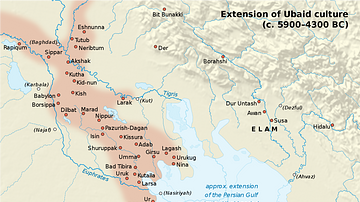
Map of Ubaid Culture
A map showing the extension of Ubaid Culture, ca. 5900 to 4300 BCE.
Image
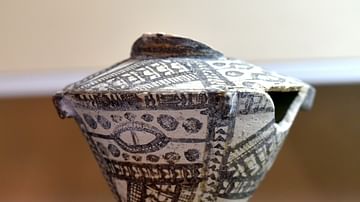
Pottery Vessel from Ninevite V Culture
This peculiar pottery vessel was found at Nineveh, Iraq. The surface is painted with different geometric shapes. Ninevite V period/culture of Upper Mesopotamia, c. 2900-2600 BCE. On display at the Iraq Museum in Baghdad.
Image
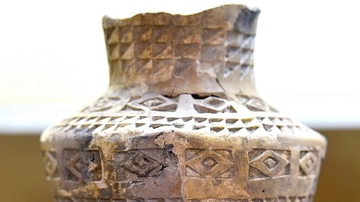
Vessel from Ninevite V Culture
This pottery vessel was found at Nineveh, Iraq. The surface is decorated with different geometric motifs and shapes. Ninevite V period/culture of Upper Mesopotamia, c. 2900-2600 BCE. On display at the Iraq Museum in Baghdad.
Image
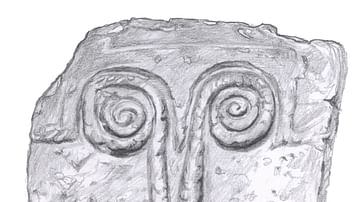
Tombstone Door (Castelluccio Culture, Sicily)
Stone door (early bronze Age, c. 2169 - c. 1500 BCE) closing of a grave dug in the rock, decorated in relief with spiral shaped motifs. On it are carved images that could allude to the sexual act and, therefore, to the continuation of life...

Image
Ritual Ceramic Wash Basin (Thapsos Culture, Sicily)
Large wash basin on a high foot with bifid handle (c. 1500-c. 1200 BCE), richly decorated with geometric engravings. Thapsos Culture, Sicily. (Pencil drawing by Gina Pardo).
