
Search
Remove Ads
Advertisement
Search Results

Definition
Arthashastra
The Arthashastra is an Indian treatise on politics, economics, military strategy, the function of the state, and social organization attributed to the philosopher and Prime Minister Kautilya (also known as Chanakya, Vishnugupta...

Definition
Faravahar
The faravahar is the best-known symbol from ancient Persia of the winged sun disk with a seated male figure in the center. It is thought to represent Ahura Mazda, the god of Zoroastrianism, but has also been interpreted to signify...

Definition
Huns
The Huns were a nomadic tribe prominent in the 4th and 5th century whose origin is unknown but, most likely, they came from "somewhere between the eastern edge of the Altai Mountains and the Caspian Sea, roughly modern Kazakhstan" (Kelly...

Definition
Ancient Britain
Ancient Britain was a landmass on the northwest of the continent of Europe first occupied by humans c. 800,000 years ago prior to it becoming an island c. 6000 BCE due to flooding which separated it from the mainland. Agriculture...
Definition
First Dynasty of Egypt
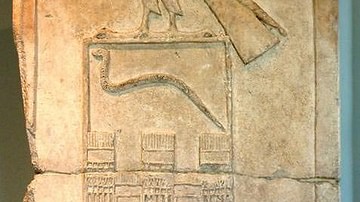
The kings of the First Dynasty of Egypt (c. 3150 - c. 2890 BCE) all worked toward the same ends: increasing trade, expansion of the kingdom through military campaigns, engaging in building projects (such as monuments, tombs...

Definition
Polycrates
Polycrates (r. c. 535-522 BCE) was the tyrant of Samos who established Samian naval supremacy in the eastern Aegean and strove for control of the Aegean Sea and mainland towns of Ionia in the 6th century BCE. Polycrates had a successful...
Definition
Haniwa
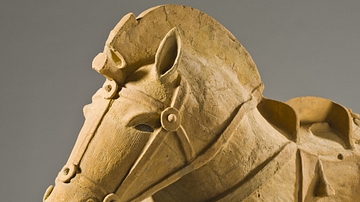
Haniwa are the unglazed terracotta rings, cylinders, and figures of people, animals, and houses which were deposited at Japanese tombs during the Kofun and Asuka Periods (c. 250-710 CE). The exact purpose of these offerings is not known...

Definition
Byzantine Architecture
The architecture of the Byzantine Empire (4th - 15th century CE) continued its early Roman traditions but architects also added new structures to their already formidable repertoire, notably improved fortification walls and...

Definition
Medieval Castle
Medieval castles were built from the 11th century CE for rulers to demonstrate their wealth and power to the local populace, to provide a place of defence and safe retreat in the case of attack, defend strategically important...

Definition
Leif Erikson
Leif Erikson (also spelled Leif Eriksson, Old Norse Leifr Eiríksson), nicknamed Leif 'the Lucky', was a Norse Viking who is best known for arguably being the first European to have set foot on North American soil along with his crew...
