
Search
Remove Ads
Advertisement
Search Results

Definition
Hadrian's Wall
Hadrian's Wall (known in antiquity as the Vallum Hadriani or the Vallum Aelian) is a defensive frontier work in northern Britain which dates from 122 CE. The wall ran from coast to coast at a length of 73 statute miles (120 km...

Definition
The Sweet Track
The Sweet Track is a Neolithic timber walkway, located in the Somerset Levels, England. It was originally part of a network of tracks built to provide a dry path across the marshy ground. The Sweet Track ran between what was then...

Definition
Copan
Copán (in modern Honduras) is located on the floodplain of the river of the same name. It was the most southerly of the Classic Maya centres and, at an altitude of 600 metres, the highest. Copán reached the height of its power in the...
Definition
Locmariaquer
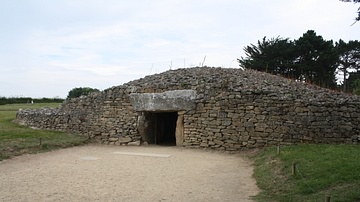
Locmariaquer is a Stone Age site in north-west France distinguished by its two large stone tombs and massive granite standing stone or menhir. The monumental structures, all built within metres of each other, were built in the 5th...

Definition
Ajanta
Approximately 67 miles (107 km) to the north of Aurangabad in the Indhyadri range of Western Ghats lie the caves of Ajanta. The 30 caves, famous for their early Buddhist temple architecture and many delicately drawn murals, are located...

Definition
Circe
Circe (also spelt Kirké) is a powerful sorceress and goddess in Greek mythology with an exceptional talent for mixing drugs. She was the daughter of the sun god Helios and the Oceanid Perseis. Circe's home was found on the wooded island...

Definition
Marcus Claudius Marcellus
Marcus Claudius Marcellus (c. 270-208 BCE) was a five-time consul and, earning the nickname the 'Sword of Rome', he was one of the city's greatest military commanders. Active in both the First and Second Punic Wars, he...

Definition
Krak Des Chevaliers
Krak des Chevaliers (also spelt Cracs des Chevaliers, and known in Arabic as Hisn al-Akrad) is a castle in Syria originally built for the Emir of Aleppo in 1031 CE but acquired and extensively rebuilt by the Knights Hospitaller...

Definition
Salado Culture
The Salado culture is a term used by historians and archaeologists to describe a pre-Columbian Southwestern culture that flourished from c. 1200-1450 CE in the Tonto Basin of what is now the southern parts of the present-day US...

Definition
Andreas Vesalius
Andreas Vesalius (1514-1564) was the most celebrated anatomist in Europe during the 16th century and a key figure of the Scientific Revolution. Vesalius' great work was his On the Fabric of the Human Body, which contains over...
