
Search
Did you mean: Epona?
Remove Ads
Advertisement
Search Results
Definition
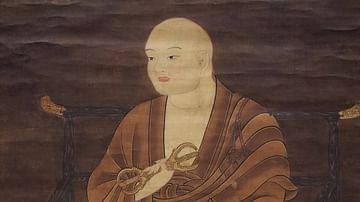
Kukai - Japan's Founder of Shingon Buddhism
Kukai or Kobo Daishi (774-835 CE) was a scholar, poet, and monk who founded Shingon Buddhism in Japan. The monk became the country's most important Buddhist saint and has been credited with all manner of minor miracles. Noted as a gifted...

Article
Tibetan Sand Mandalas
Tibetan sand mandalas are works of art created to encourage healing, peace, and purification generally as well as spiritual or psychological focus specifically for those creating and viewing it. A mandala (Sanskrit for "circle") is a geometric...

Definition
Illuminated Manuscripts
Illuminated manuscripts were hand-made books, usually on Christian scripture or practice, produced in Western Europe between c. 500-c. 1600. They are so called because of the use of gold and silver which illuminates the text and accompanying...

Definition
Cardinal Thomas Cajetan
Cardinal Thomas Cajetan (l.c. 1468-1534) was a Catholic theologian and philosopher best known for his disputations with Martin Luther (l. 1483-1546) beginning in 1518. Cajetan, a philosophical Humanist, was thought to have had the best chance...
Definition
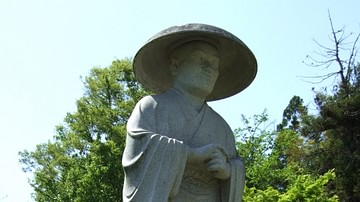
Ennin
Ennin (c. 793-864 CE, posthumous title: Jikaku Daishi) was a Japanese Buddhist monk of the Tendai sect who studied Buddhism at length in China and brought back knowledge of esoteric rituals, sutras, and relics. On his return, he published...
Definition
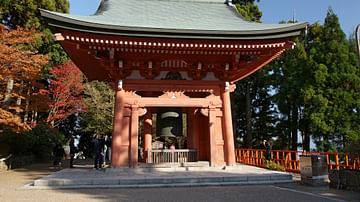
Enryakuji
The Enryakuji is a Buddhist monastic complex on the sacred Mt. Hiei, near Kyoto, Japan. The site was selected by the monk Saicho to become the headquarters of the Tendai sect, which he founded in Japan in the early 9th century CE. Enryakuji...
Article
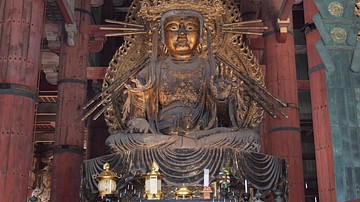
Buddhism in Ancient Japan
Buddhism was introduced to ancient Japan via Korea in the 6th century CE with various sects following in subsequent centuries via China. It was readily accepted by both the elite and ordinary populace because it confirmed the political and...

Article
The History of Japanese Green Tea
The history of green tea in Japan goes back to the 8th century when it was a popular stimulant for meditating monks. In this article, we examine tea's origins and cultivation, how it became an integral part of Japanese culture, the symbolism...
Article
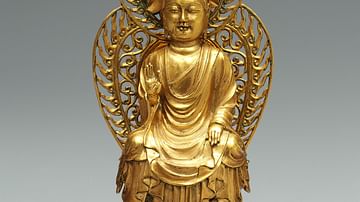
Buddhism in Ancient Korea
Buddhism, in Korean Bulgyo, was introduced by monks who visited and studied in China and then brought back various Buddhist sects during the Three Kingdoms period. It became the official state religion in all Three Kingdoms and subsequent...

Article
15 Complete Hyangga Songs from Ancient Korea
Hyangga was a form poetical 'country song,' distinct from contemporary Chinese songs, which were written in the Silla and Goryeo kingdoms of ancient Korea between the 7th and 10th century CE. The indigenous songs cover such topics as love...
