
Search
Remove Ads
Advertisement
Search Results

Definition
Ancient Chinese Art
Ancient China covered a vast and ever-changing geopolitical landscape, and the art it produced over three millennia is, unsurprisingly, just as varied. Still, despite continuous indigenous technical developments, changes in...
Definition
Cheonmachong
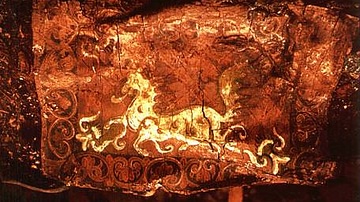
Cheonmachong is a 5-6th-century CE royal tomb of the ancient Silla kingdom of Korea located at the Daereungwon Tomb Complex in Gyeongju. It is popularly known as the 'Heavenly Horse Tomb' because of a painting of that animal on a...

Definition
Ancient Egyptian Literature
Ancient Egyptian literature comprises a wide array of narrative and poetic forms including inscriptions on tombs, stele, obelisks, and temples; myths, stories, and legends; religious writings; philosophical works; wisdom...

Definition
Villanovan Culture
The Villanovan culture flourished during the Iron Age in central Italy from c. 1000 to c. 750 BCE. It was a precursor of the Etruscan civilization, although the two populations are actually the same and the term Villanovan should...

Definition
Kofun
Kofun (old tumuli) are large artificial mound tombs built in ancient Japan for the ruling elite between the 3rd and 7th century CE. Many measure several hundred metres across, are surrounded by a moat, and, besides containing valuable...

Definition
Timbuktu - West Africa's Great Trading Centre
Timbuktu (Timbuctoo) is a city in Mali, West Africa which was an important trade centre of the Mali Empire which flourished between the 13th and 15th centuries. The city, founded c. 1100, gained wealth from...

Definition
Urartu Religion
The religion of the Urartu civilization, which flourished principally in ancient Armenia from the 9th to 6th century BCE, was a unique mix of indigenous, Hurrian and Mesopotamian gods and symbolism. The pantheon was headed by...

Definition
Prambanan
Prambanan (Javanese: Rara Jonggrang) is a Hindu temple complex dating from the 9th century CE located near Bokoharjo, on the island of Java in Indonesia. Prambanan is the largest Hindu temple in Indonesia and one of the largest Hindu...

Definition
Azuchi-Momoyama Period
The Azuchi-Momoyama Period (Azuchi-Momoyama Jidai, aka Shokuho Period, 1568/73 - 1600 CE) was a brief but significant period of medieval Japan's history which saw the country unified after centuries of a weak central government...
Definition
Gundestrup Cauldron
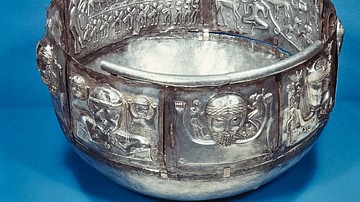
The Gundestrup Cauldron is a gilded silver bowl found in Gundestrup in Denmark in 1891 CE. It was likely made in the Balkans, perhaps in the 1st century BCE, and shows a clear influence from Celtic art and mythology, even if...
