
Search
Remove Ads
Advertisement
Search Results

Image
Royal Mausoleum of Mauretania, Algeria
The Royal Mausoleum of Mauretania near Tipasa in Algeria is a funerary monument built in 3 BCE by Juba II of Numidia (c. 50 BCE- c. 25 CE) and his wife Cleopatra Selene II (40 BCE-c. 5 BCE). This tomb may have been their final resting place...

Article
Rome under the Julio-Claudian Dynasty
The Julio-Claudians were the first dynasty to rule the Roman Empire. After the death of the dictator-for-life Julius Caesar in 44 BCE, his adopted son Octavian - later to become known as Augustus (r. 27 BCE - 14 CE) - fought a civil war against...

Image
Mausoleum at Halicarnassus, Reconstructed
The Mausoleum at Halicarnassus was built c. 351 BCE for the Persian satrap Mausolus. The massive structure is one of the Seven Wonders of the Ancient World.
This gif is a reconstruction of what the mausoleum would look like today.

Image
Statue of a Horse from the Mausoleum at Halicarnassus
This is a forepart of a horse from the chariot-group surmounting the Mausoleum at Halicarnassus, also known as the Tomb of Mausolus . From the north side of the peribolus wall of the Mausoleum. Classical Greek Period, circa 350 BCE. The British...
Image
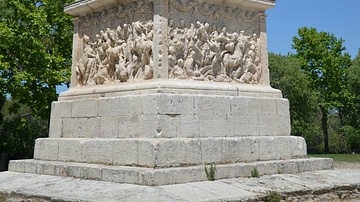
Mausoleum of the Julii
The Mausoleum of the Julii at Glanum, southern France, is one of the best preserved mausoleums of the Roman era. Based on its artistic style, the Mausoleum was probably built between 40 and 20 BCE. An inscription mentions that three Julius...

Definition
The Seven Wonders
The Seven Wonders of the Ancient World were seven impressive structures famously listed by ancient writers including Philo of Byzantium, Antipater of Sidon, Diodorus Siculus, Herodotus, Strabo, and Callimachus of Cyrene, among others. The...

Image
Map of the Provinces of the Roman Empire under Augustus
This map illustrates the expansion of the Roman Republic during the military campaigns and conquests of Julius Caesar (100–44 BCE), and its transformation into an empire under the reign of Caesar Augustus (63 BCE–14 CE), also known as Octavian...

Article
The Splendours of Roman Algeria
Algeria, Africa's largest country, stretches from the Mediterranean coastline to the Saharan desert interior. The country has some of the finest and most diverse Roman sites, including Timgad and Djémila, both well-preserved and UNESCO-listed...
Image
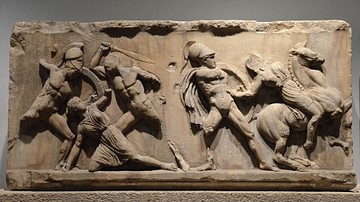
Amazonomachy Relief from the Mausoleum at Halicarnassus
Slab from the Amazonomachy frieze depicting five figures, three Greeks and two Amazons, and a horse. From the Mausoleum at Halicarnassus, around 350 BCE (British Museum).
Image
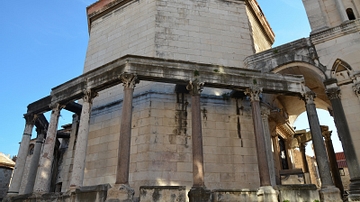
Diocletian's Mausoleum
The octagonal mausoleum of Diocletian (now Cathedral of St. Domnius) inside Diocletian's Palace, Split (Croatia). Diocletian's Palace was built between 293-303 CE in preparation for his retirement on 1 May 305 CE.
