
Search
Did you mean: Mithra?
Remove Ads
Advertisement

 This answer was generated by
Search Results

Article
Cultural Links between India & the Greco-Roman World
Cyrus the Great (558-530 BCE) built the first universal empire, stretching from Greece to the Indus River. This was the famous Achaemenid Empire of Persia. An inscription at Naqsh-i-Rustam, the tomb...

Definition
Gupta Empire
The Gupta Empire stretched across northern, central and parts of southern India between c. 320 and 550 CE. The period is noted for its achievements in the arts, architecture, sciences, religion, and philosophy. Chandragupta I (320...

Definition
Krishna
Krishna (Krsna or Hari Krishna) is a major god of the Hindu pantheon and considered the eighth incarnation of Vishnu. He is perhaps the most popular of all the heroes of Hindu mythology. Krishna's adventures appear in the Mahabharata...

Definition
Gupta Architecture
The Gupta Dynasty (4th-6th century) in North Central India saw the first purpose-built Hindu (and also Buddhist) temples which evolved from the earlier tradition of rock-cut shrines. Adorned with towers and elaborate carvings...

Definition
Gandhara Civilization
The Gandhara Civilization existed in what is now Northern Pakistan and Afghanistan from the middle of the 1st millennium BCE to the beginning of the 2nd millennium CE. Although multiple major powers ruled over this area during...

Definition
Samudragupta
Samudragupta (r. 335/350 - 370/380 CE) was the first significant ruler of the Gupta Dynasty. Having come to the throne, he decided to extend the boundaries of his empire to cover the multiple kingdoms and republics that existed outside...

Definition
Magadha Kingdom
Magadha was an ancient kingdom located on the Indo-Gangetic plains in eastern India and spread over what is today the modern state of Bihar. At the height of its power, it claimed suzerainty over the entire eastern part of the...

Image
Head of a Jain Tirthankara
This head belongs to a jina ("conqueror" or "liberator"), a Jain saint who severed the chain of rebirth and achieved a state of omniscience known as nirvana. Jains believe that there have been 24 jinas, each of whom is...
Image
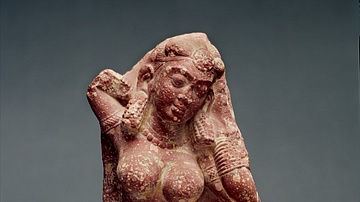
Yakshi
Mathura region: Yakshi, ca. second century CE: sandstone. The William A. Whitaker Foundation Art Fund. Republished with permission from the Ackland Art Museum. Credit: 84.2.1 Unidentified Artist Indian, Mathura region: Yakshi...

Article
Siege Warfare in Ancient India
Forts and sieges held a key position in ancient Indian warfare. Built on considerations of strategic location, topography, and the natural advantages provided by the site, forts would be heavily supplemented with man-made...
