
Search
Did you mean: Serket?
Remove Ads
Advertisement
Search Results

Image
Twelve Spices That Changed the World - Trade, Empire, and the Global Age of Spices, 1450–1650
Between c. 1450 and 1650, demand for spices and other high-value plant commodities became an important catalyst for European maritime expansion. Pepper, cinnamon, cloves...
Image
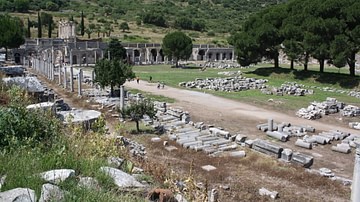
Roman Agora, Ephesus
The Agora (or market place) of Ephesos was first built in the 3rd century BC but was adapted over the Roman period to reach its final form in the early 3rd century AD. On a square plan (111m x 111m) the Agora was accessible...

Curriculum Collection
AP World History Unit 5 - Revolutions (c. 1750–1900)
Two major revolutions remade the world between 1750 and 1900. The first was a revolution of the mind: thinkers of the Enlightenment argued that authority was based upon reason and consent, rather than...
Image
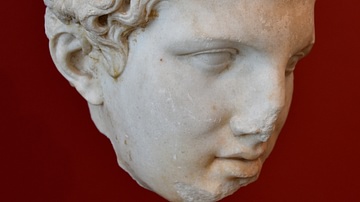
Portrait of a Hellenistic Ruler
This partly preserved head of a young man with idealized facial features is understood to represent a Hellenistic ruler, due to the band in his curly hair. Certain classification is however not possible. Historically...

Collection
Trade in the Middle Ages
Peoples, cities and states have traded since antiquity but in the medieval period, things escalated so that goods travelled ever greater distances by land, river and sea. Great cities arose thanks to commerce and international...

Image
Head of Polykletian Discophoros
This high-quality head of a statue is based on a bronze figure of a discophoros ("disc-thrower"). The original bronze was created around 460 BCE by the famous Greek sculptor Polykleitos of Argos. The Berlin copy clearly...
Image
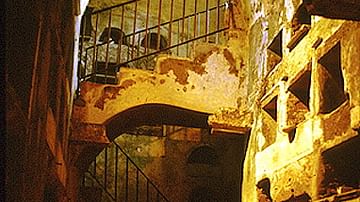
Columbarium 3 at Vigna Codini: View of Double Staircase
This largely first-century CE columbarium in Rome, discovered in 1852 CE, was once lined with marble. It is very 'up-market' in that the epitaphs are all preoccupied with status, even though the...

Video
Zeibekikos - Ayla Heritage of Greece
The Zeibekiko dance holds an important place in various local communities, where the 'glentistades', and the 'kouvardades' meraklides singers and local dancers still rescue and promote - through the rich folk...
Image
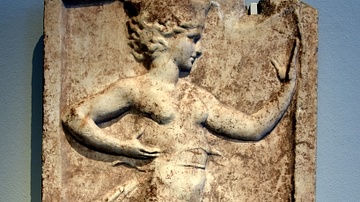
Relief of Kalathiskos Dancer
This is a Neo-Attic relief of the so-called "kalathiskos dancer". The relief shows a dancing woman in waving robes and with a basket-like headdress (kalathiskos). Stylistically, the relief can be attributed to the so-called...
Image
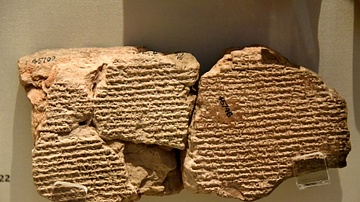
Tablet Describing Parthian Conquest of Babylonia
This tablet is written in cuneiform inscription and refers to the defeat of the Seleucid king Demetrius II Nicator by the Parthian ruler Mithradates I in 141 BCE. The Parthian ruler is referred to as...
