
Search
Remove Ads
Advertisement
Search Results

Article
The Column of Marcus Aurelius
The Column of Marcus Aurelius and Faustina which stands in Piazza Colonna in Rome is thought to have been erected by Commodus in memory of his father and mother sometime around 180 CE. The column was inspired by its more famous predecessor...

Video
Marcus Aurelius: The Philosopher & Emperor of the Roman Empire
Marcus Aurelius (r. 161 to 180 CE) was a Roman emperor best known as the last of the Five Good Emperors of Rome (following Nerva, Trajan, Hadrian, and Antoninus Pius) and as the author of the philosophical work Meditations. Although it has...

Definition
Roman Philosophy
Roman philosophy played a significant role in the growth and development of Western thought. While not involved directly in the development of original philosophical thought, Rome made significant contributions in two ways: by conveying Greek...

Image
Marcus Junius Brutus
A depiction of Marcus Junius Brutus (85-42 BCE), the most infamous of the assassins of Julius Caesar (100-44 BCE).

Image
Gold ring with Coin of Emperor Marcus Aurelius
Roman gold coins were set into rings to be worn. Decorative frames were added to turn others into brooches. The image of the emperor was believed to be a good luck charm, so it made sense to carry it around all the time. Gold coin of Emperor...

Definition
Julius Caesar
Gaius Julius Caesar was born 12 July 100 BCE (though some cite 102 as his birth year). His father, also Gaius Julius Caesar, was a Praetor who governed the province of Asia and his mother, Aurelia Cotta, was of noble birth. Both held to the...
Image
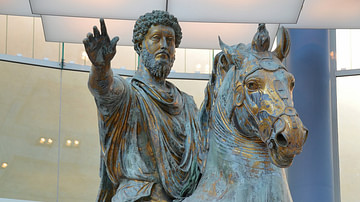
Equestrian Statue of Marcus Aurelius
The Equestrian Statue of Marcus Aurelius is an ancient Roman statue in gilded bronze. The statue was erected in 175 CE. Its original location is debated: the Roman Forum and Piazza Colonna have been proposed. (Capitoline Museums, Palazzo...

Image
Marcus Aurelius Equestrian Statue
A bronze gilded statue of Roman emperor Marcus Aurelius, larger-than-lifesize and most probably erected in 176 CE and placed in Rome, perhaps in the Forum. (Capitoline Museums, Palazzo dei Conservatori, Rome).
Image
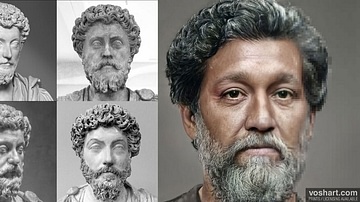
Marcus Aurelius (Artistic Facial Reconstruction)
A photorealistic representation of what the Roman emperor Marcus Aurelius (r. 161-180 CE) may have looked like. Based on contemporary and near contemporary descriptions, as well as archaeological evidence. Pictured alongside the reconstruction...

Image
Marcus Licinius Crassus Bust
A bust of Roman statesman and general Marcus Licinius Crassus (c. 115-53 BCE). Glyptothek, Copenhagen.
