
Search
Remove Ads
Advertisement
Search Results

Definition
Ancient Greek Warfare
In the ancient Greek world, warfare was seen as a necessary evil of the human condition. Whether it be small frontier skirmishes between neighbouring city-states, lengthy city-sieges, civil wars, or large-scale battles between...

Article
The Royal Macedonian Tombs at Vergina
Excavations at Vergina in northern Greece in the late 1970s CE unearthed a cluster of tombs thought to be the burial site of Philip II (r. 359-336 BCE), the father of Alexander the Great (r. 336-323 BCE), with...

Definition
Aetolian League
The Aetolian League was an ancient Greek alliance of the tribes that lived west of Athens and north of the Peloponnese. The league was probably first established in the early 4th century BCE, reached its peak during the Hellenistic...

Image
Greek Phalanx
A scene depicting the Greek phalanx composed of heavily armed hoplite warriors.

Article
The Army of Alexander the Great
No military commander in history has ever won a battle by himself. To be successful he needs the support of a well-trained army who will follow him regardless of the cost whether it be a stunning victory or hopeless...

Definition
Sacred Band of Thebes
The Sacred Band of Thebes was an elite unit of the Theban army comprised of 150 gay male couples totaling 300 men. They were formed under the leadership of Gorgidas but first achieved fame under the general Pelopidas. They...
Definition
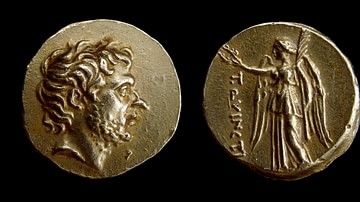
Titus Quinctius Flamininus
Titus Quinctius Flamininus (229-174 BCE) was a consul and military commander of the Roman Republic during the Second Macedonian War, who decisively defeated Philip V of Macedon (r. 221-179 BCE) at the Battle of Cynoscephalae...

Article
The Hypaspists in Ancient Sources
Hypaspist translitterates the Greek term meaning shield-bearer, or armour-bearer (ὁ ὑπασπιστής). This noun is formed from the verb ὑπασπίζειν - to carry the shield for another; serve as a shieldbearer. The Shieldbearers...

Definition
Alexander the Great
Alexander III of Macedon, better known as Alexander the Great (l. 21 July 356 BCE – 10 or 11 June 323 BCE, r. 336-323 BCE), was the son of King Philip II of Macedon (r. 359-336 BCE) who became king upon his father's death in...

Video
Phalanx vs Legion: Battle of Cynoscephalae
The Roman victory in the Battle of Cynoscephalae ( 197 BC ) marked the end of the Second Macedonian War between Rome and Philip V, king of Macedon. The battle is considered one of the best examples of manipular...
