
Search
Did you mean: Lamia?
Remove Ads
Advertisement
Search Results

Definition
Jan van Eyck
Jan van Eyck (c. 1390-1441 CE) was a Netherlandish Renaissance painter who was famous in his own lifetime for his mastery of oil painting, colouring, naturalistic scenes, and eye for detail. Amongst his masterpieces are the 1432...

Definition
Ardagh Chalice
The Ardagh Chalice, one of the finest examples of Irish metalwork from the Middle Ages, was found in 1868 CE as part of a hoard at an Irish ringfort in Reerasta, near Ardagh, Co. Limerick. While the chalice is the only ecclesiastical...
Definition
Malcolm III of Scotland
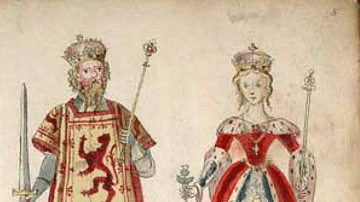
Malcolm III of Scotland (aka Máel Coluim mac Donnchada) reigned as king from 1058 to 1093 CE. He took the throne after his young predecessor Lulach (r. 1057-1058 CE), the stepson of Macbeth, king of Scotland (r. 1040-1057...
Definition
Pope Joan
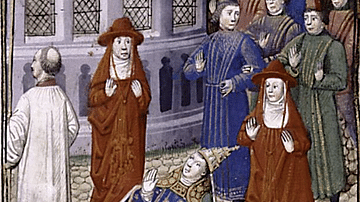
Pope Joan was a legendary female pope of the Middle Ages said to have reigned from 855 to 858. After her story was popularized by Italian writer Giovanni Boccaccio (1313-1375), a statue of her was placed alongside those of other popes...
Definition
Sextus Empiricus
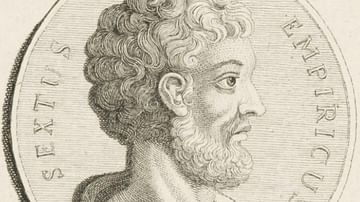
Sextus Empiricus (l. c. 160 to c. 210 CE) was a Greek Skeptic who developed the ideas of the earlier Greek Skeptic philosopher Pyrrho of Elis (l. c. 360 to c. 270 BCE) who claimed that tranquility of mind was attainable by suspending...

Definition
William III of England
William III of England (also William II of Scotland, r. 1689-1702) became king of England, Scotland, and Ireland after the Glorious Revolution of 1688. Protestant William, Prince of Orange, was invited to rule jointly with...

Definition
Mesopotamian Literature - The Earliest Works of the Imagination
Ancient Mesopotamian literature developed circa 2600 BCE after scribes, who had formerly been record-keepers, began composing original works in the region of Sumer. The Sumerians invented writing...

Definition
Edward Gibbon
Edward Gibbon (1737-1794) was an English historian most famous for his influential work The History of the Decline and Fall of the Roman Empire, volume one of which was published in 1776, with the final sixth volume coming in 1788...

Definition
Mercury (Deity)
Mercury (Mercurius) was the Roman god of commerce, often serving as a mediator between the gods and mortals, his winged feet giving him the advantage of speed, and so was the patron of circulation in general - of people, goods...

Definition
Andreas Vesalius
Andreas Vesalius (1514-1564) was the most celebrated anatomist in Europe during the 16th century and a key figure of the Scientific Revolution. Vesalius' great work was his On the Fabric of the Human Body, which contains over...
