
Search
Remove Ads
Advertisement
Search Results
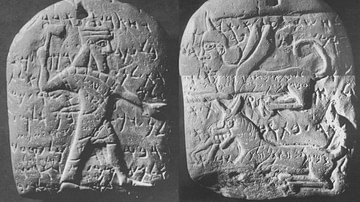
Definition
Arslan Tash Amulet
Dated to the 7th century BCE, the Arslan Tash amulet (AT1) was discovered in Arslan Tash, Syria and contains the writing of Phoenician, magic incantations. The limestone plaque includes a variety of features: incantations perceived...

Article
Cultural Links between India & the Greco-Roman World
Cyrus the Great (558-530 BCE) built the first universal empire, stretching from Greece to the Indus River. This was the famous Achaemenid Empire of Persia. An inscription at Naqsh-i-Rustam, the tomb...

Definition
Sumer - The Cradle of Civilization
Sumer was the southernmost region of ancient Mesopotamia (modern-day southern Iraq and parts of Kuwait), which has long been considered the cradle of civilization. The name comes from Akkadian, the language of the...

Definition
Elam - The Ancient High Country
Elam was a region in the Near East corresponding to the modern-day provinces of Ilam and Khuzestan in southern Iran (though it also included part of modern-day southern Iraq) whose civilization spanned thousands of...

Definition
Brahmi Script
The Brahmi script is the earliest writing system developed in India after the Indus script. It is one of the most influential writing systems; all modern Indian scripts and several hundred scripts found in Southeast and East Asia...

Definition
White Huns (Hephthalites)
The White Huns were a race of largely nomadic peoples who were a part of the Hunnic tribes of Central Asia. They ruled over an expansive area stretching from the Central Asian lands all the way to the Western Indian Subcontinent...

Definition
Side
Side (pronounced see-day) was a city on the southern coast of Cilicia (modern-day Turkey) first settled in the 7th century BCE by immigrants from Cyme, an Aeolian municipality to the north near the kingdom of Lydia. Its name means 'pomegranate'...

Definition
Uruk - The First Great City
Uruk was one of the most important cities (at one time, the most important) in ancient Mesopotamia. According to the Sumerian King List, it was founded by King Enmerkar circa 5000/4500 BCE. Uruk is best known as the birthplace...

Definition
Swahili Coast
The Swahili Coast on the shores of East Africa was a region where Africans and Arabs mixed to create a unique identity from the 8th century called Swahili Culture. Swahili is the name of their language and means 'people of the coast.'...

Definition
Egyptian Hieroglyphs
The Egyptian hieroglyphic script was one of the writing systems used by ancient Egyptians to represent their language. Because of their pictorial elegance, Herodotus and other important Greeks believed that Egyptian hieroglyphs...
