
Search
Did you mean: Khitan?
Remove Ads
Advertisement
Search Results

Image
Initiation of Kublai Khan
Initiation of Kublai (Qubilai) Khan and Offering Tibet to Phakpa in 1264 CE; Tibet; c. 16th–17th century; pigments on cloth; 24 1/4 x 15 1/8 in. (61.5 x 38.4 cm); Rubin Museum of Art; C2002.3.2 (HAR 65046)

Image
An Audience with Mongke Khan
A mid-15th century CE manuscript illustration showing an audience with Mongke Khan, ruler of the Mongol Empire from 1251 to 1259 CE. From the 'Tarikh-i Jahangushay-i Juvaini' by Ata-Malik Juvayni (1226-1283 CE). (National Library of France...

Image
Kublai Khan Naming Phakpa Imperial Preceptor
Kublai (Qubilai) Khan Naming Phakpa Imperial Preceptor, c. 1270 CE; attributed to Khyentse Chenmo (flourished 1450s–1490s CE); Tibet; late 15th–16th century CE; pigments on cloth; 32 1/4 x 20 in. (82.6 x 50.8 cm); Art Gallery of Greater Victoria...
Image
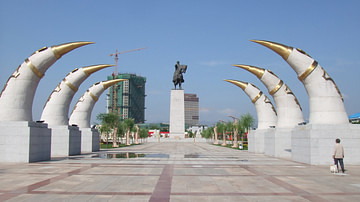
Monument of Genghis Khan, Hohhot
The monument of Genghis Khan (c. 1162/67-1227 CE), ruler and founder of the Mongol Empire (1206-1368 CE). (Hohhot, Inner Mongolia, China)

Definition
Mongol Warfare
The Mongols conquered vast swathes of Asia in the 13th and 14th century CE thanks to their fast light cavalry and excellent bowmen, but another significant contribution to their success was the adoption of their enemies' tactics and technology...

Image
Chagatai Khan
A modern representation of the Mongol leader Chagatai Khan (1183-1242 CE), the second oldest son of Genghis Khan (r. 1206-1227 CE), who was the first ruler of the Chagatai Khanate. (Mongol palace, Gachuurt, Mongolia)

Image
Ivan the Great Tearing the Khan's Letter to Pieces
Ivan the Great Tearing the Khan's Letter to Pieces, oil on canvas by Aleksey Kivshenko (1851-1896).

Definition
Golden Horde
The Golden Horde was the European appanage of the Mongol Empire (1206-1368 CE). Begun in earnest by Batu Khan in 1227 CE, the territory that would eventually become the Golden Horde came to encompass parts of Central Asia, much of Russia...

Article
The Nerge: Hunting in the Mongol Empire
The peoples of the Mongol Empire (1206-1368 CE) were nomadic, and they relied on hunting wild game as a valuable source of protein. The Asian steppe is a desolate, windy, and often bitterly cold environment, but for those Mongols with sufficient...
Article
Mongol Multiculturalism
The Mongol Empire accepted and promoted many other cultures. Historians often talk about cultural exchange across Asia in the Mongol Empire as something that was just facilitated by peace and stability across such a huge area – the 'Pax Mongolica'...
