
Search
Remove Ads
Advertisement
Search Results

Article
Daily Life in Ancient Egypt
The popular view of life in ancient Egypt is often that it was a death-obsessed culture in which powerful pharaohs forced the people to labor at constructing pyramids and temples and, at an unspecified time, enslaved...

Article
Egyptian Gods - The Complete List
The gods and goddesses of Ancient Egypt were an integral part of the people's everyday lives for over 3,000 years. There were over 2,000 deities in the Egyptian pantheon, many whose names are well known - Isis, Osiris...

Article
Trade in Ancient Egypt
Trade has always been a vital aspect of any civilization whether at the local or international level. However many goods one has, whether as an individual, a community, or a country, there will always be something one lacks...

Definition
Egyptian Book of the Dead
The Egyptian Book of the Dead is a collection of spells which enable the soul of the deceased to navigate the afterlife. The famous title was given the work by western scholars; the actual title would translate as The...
Article
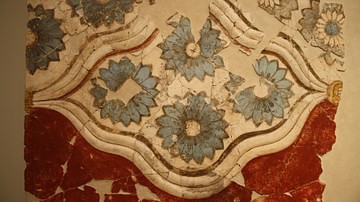
Akrotiri Frescoes
The Bronze Age frescoes from Akrotiri on the Aegean island of Thera (modern-day Santorini) provide some of the most famous images from the ancient Greek world. Sometime between 1650 and 1550 BCE Thera suffered a devastating earthquake...

Article
Prayer to Thoth for Skill in Writing
The Prayer to Thoth for Skill in Writing is a literary piece dated to c. 1150 BCE from the latter period of the New Kingdom of Egypt (c. 1570- c. 1069 BCE) in which a young scribe prays for inspiration to Thoth...

Definition
Ancient Egypt - The Land of the Gods of Balance and Harmony
Egypt is a country in North Africa, on the Mediterranean Sea, and is home to one of the oldest civilizations on Earth. The name "Egypt" comes from the Greek Aegyptos, which was the Greek pronunciation...
Image
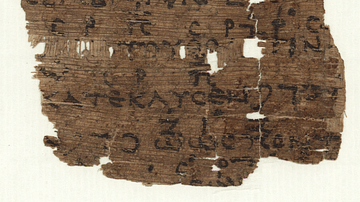
Euripides, Orestes, 338-44: Musical Fragment
This papyrus was written around 200 BCE in Hermopolis, Egypt, and contains seven fragmentary lines (338–344) from the first chorus of Euripides, Orestes. The fragment contains vocal and instrumental symbols...
Article
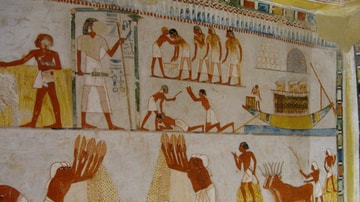
Jobs in Ancient Egypt
In ancient Egypt, the people sustained the government and the government reciprocated. Egypt had no cash economy until the coming of the Persians in 525 BCE. The people worked the land, the government collected the bounty...

Article
Cosmetics, Perfume, & Hygiene in Ancient Egypt
For the ancient Egyptians life was a celebration, and so, just as one would want to look one's best at any party, personal hygiene was an important cultural value. The Egyptians bathed daily, shaved their...
