
Search
Remove Ads
Advertisement
Search Results

Definition
The Hittites
The Hittites occupied the ancient region of Anatolia (also known as Asia Minor, modern-day Turkey) prior to 1700 BCE, developed a culture apparently from the indigenous Hatti (and possibly the Hurrian) people, and expanded their...

Definition
Kingdom of Saba
Saba (also given as Sheba) was a kingdom in southern Arabia (region of modern-day Yemen) which flourished between the 8th century BCE and 275 CE when it was conquered by the neighboring Himyarites. Although these are the most...

Definition
Adolf Hitler
Adolf Hitler (1889-1945) was the dictator of Nazi Germany from 1933. He gained power by making popular promises like improving Germany's economy and status in Europe, but when he took these policies too far, he was responsible more...

Definition
George II of Great Britain
George II of Great Britain (r. 1727-1760) was the second of the Hanoverian monarchs, and like his father George I of Great Britain (r. 1714-1727), he faced a Jacobite rebellion to restore the Stuart line. Wars in Europe...

Definition
Józef Poniatowski
Prince Józef Poniatowski (1763-1813) was a Polish soldier and patriot, who served as commander-in-chief of the Polish army during the Napoleonic Wars (1803-1815). A steadfast ally of French Emperor Napoleon I (r. 1804-1814; 1815...

Definition
Hellenistic Period
The Hellenistic Period is a part of the Ancient Period for the European and Near Asian space. The use of this period is justified by the extent of the Hellenic culture in most of these areas, due to the Greek political presence...

Definition
Bucephalus
Bucephalus was Alexander the Great's horse and is considered by some to be the most famous horse in history. Alexander and Bucephalus' initial meeting was unique but demonstrated the true character of one of the greatest generals...

Definition
Byzantine Emperor
The Byzantine Emperor ruled as an absolute monarch in an institution which lasted from the 4th to 15th century CE. Aided by ministers, high-ranking nobility, and key church figures, the emperor (and sometimes empress) was commander-in-chief...

Definition
Artemisia I of Caria
Artemisia I of Caria (l. 480 BCE) was the queen of the Anatolian region of Caria (south of ancient Lydia, in modern-day Turkey). She is most famous for her role in the naval Battle of Salamis in 480 BCE in which she fought...
Definition
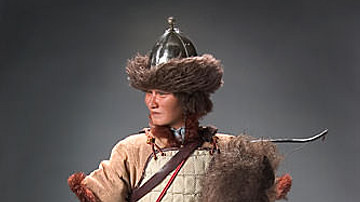
Attila the Hun
Attila the Hun (r. 434-453 CE) was the leader of the ancient nomadic people known as the Huns and ruler of the Hunnic Empire, which he established. His name means "Little Father" and, according to some historians, may not have...
