
Search
Remove Ads
Advertisement
Search Results

Definition
Hyangga
Hyangga was a form poetical 'country song,' distinct from contemporary Chinese songs, which were written in the Silla and Goryeo kingdoms of ancient Korea between the 7th and 10th century CE. The indigenous songs cover such topics as...
Definition
Pyramid
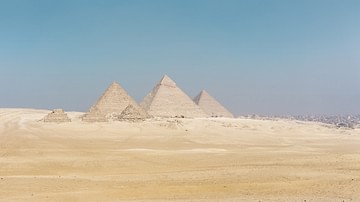
A pyramid is a structure or monument, usually with a quadrilateral base, which rises to a triangular point. In the popular imagination, pyramids are the three lonely structures on the Giza plateau at the edge of the Sahara Desert but...

Definition
Saga
The Old Norse word saga means 'story', 'tale' or 'history' and normally refers specifically to the epic prose narratives written mainly in Iceland between the 12th- and 15th centuries CE, covering the country's history as well as Scandinavia's...

Definition
Ancient Persian Warfare
The ancient Persian military evolved from the earlier armed forces of the Medes which, in turn, developed from the warrior class of the indigenous people of the Iranian Plateau, the Aryan migrants (including the Persians...

Definition
Thomas Morton
Thomas Morton (l. c. 1579-1647 CE) was an English lawyer, poet, writer, and an early colonist of North America who established the utopian community of Merrymount, sparking conflict with his separatist neighbors at Plymouth Colony...

Definition
Serpent Mound
Serpent Mound (also known as Great Serpent Mound) is an archaeological and historic site in Peebles, Ohio, USA, enclosing an effigy mound 1348 feet (411 m) long in the shape of a serpent, the largest effigy mound of a serpent in...

Definition
Andrew Jackson - The Populist President
Andrew Jackson (1767-1845) was an American military officer and politician who served as the seventh president of the United States from 1829 to 1837. From humble beginnings as a frontier lawyer in Tennessee...

Definition
Diego de Almagro
Diego de Almagro (c. 1475-1538) was a Spanish conquistador who was second-in-command to Francisco Pizarro (c. 1478-1541) during his expedition that attacked the Inca civilization from 1531. Almagro then led his own expedition...
Definition
Antiochia ad Cragum
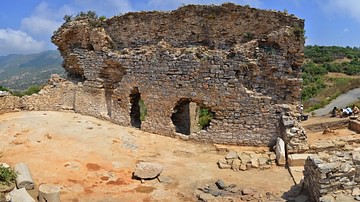
Antiochia ad Cragum (“Antioch on the Cliffs” or “Antioch at Cragus”) was a Hellenistic Roman city located in Cilicia Trachea (“Rough Cilicia”, also known as Cilicia Aspera and Cilicia Secunda) on the southern coast of modern-day...

Definition
Popol Vuh
The Popol Vuh is the story of creation according to the Quiche Maya of the region known today as Guatemala. Translated as `The Council Book', The Book of the People' or, literally, `The Book of the Mat', the work has been referred...
