
Search
Remove Ads
Advertisement
Search Results
Definition
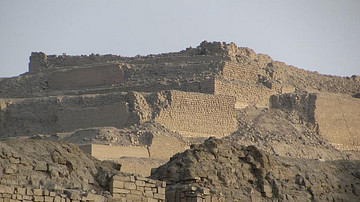
Pachacamac
Pachacamac, located on the coast of Peru and 32 km south of Lima, was an important sacred site, oracle, and place of burial, which was visited by pilgrims of many ancient Andean cultures, including the Incas. The site, active for...

Image
Bhutanese Textiles
Traditional Bhutanese handwoven textiles.

Video
The Rise and Fall of the Inca Empire: A Short History
The Inca civilisation flourished in Peru and surrounding areas between 1400 and 1533 CE. Prior to the Inca being dominant in Western South America, the Chimu occupied the area until 1470 when the...

Image
Pachacuti Inca Yupanqui
A statue of Inca ruler Pachacuti Inca Yupanqui (r. 1438-71 CE) in Plaza de Armas, Cuzco, Peru

Image
Map of the Inca Empire - Expansion and Roads
The Inca Empire (c. 13th–16th century CE) expanded from a small highland kingdom centered in Cusco into the largest pre-Columbian empire in the Americas. Emerging under leaders such as Manco Cápac and later...

Image
Inca Tunic
An Inca royal tunic with the typical geometrical designs and colours favoured by Inca weavers. (Dumbarton Oaks Research Library & Collections, Washington D.C.)
Image
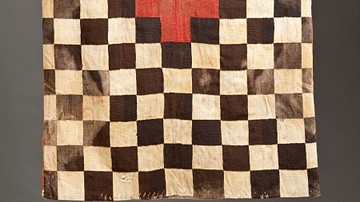
Inca Military Tunic
The standard military tunic of the Inca civilization, c. 1400 and 1533 CE. In Inca art black represented death and red represented blood and conquest. (Los Angeles County Museum of Art, L.A.)
Image
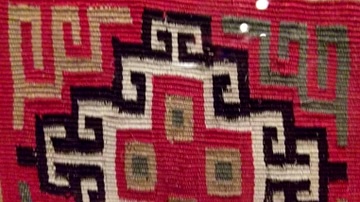
Inca Geometric Textile Motif
A detail from an Inca textile showing a geometric cross design. (Museo de America, Madrid)

Image
Inca Textile Bag
An Inca textile bag with typical tassle decoration. (Lombards Museum)

Video
Inca ushnus: landscape, site and symbol in the Andes
For three years, a research team from the British Museum, the University of Reading, Royal Holloway University of London and the Universidad Nacional de San Cristobal de Huamanga set out to discover...
