
Search
Remove Ads
Advertisement

 This answer was generated by
 Search Results
Definition
Roman Imperial Cult
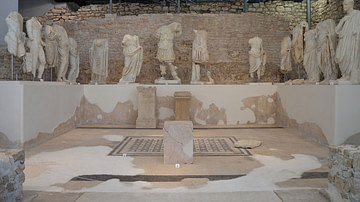
The Roman imperial cult was the practice of venerating Roman emperors and their families as having divine attributes, honoring their contributions to the spread of Roman religion and culture. It was instituted by the first Roman emperor Augustus...
Article
The Civil Service Examinations of Imperial China
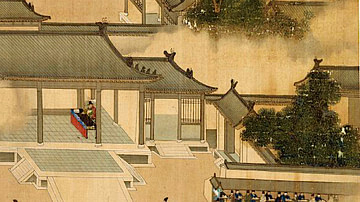
The civil service examinations of Imperial China allowed the state to find the best candidates to staff the vast bureaucracy that governed China from the Han Dynasty onwards (206 BCE - 220 CE). The exams were a means for a young male of any...

Article
Follow the Money. The Coinage of Later Imperial Rome: A Reflection of Economic Stress and Decline
Unlike the practice of professional numismatists, I prefer to see the “big picture”. So, my entire Roman coin collection, all 250 pieces, from Julius Caesar to Valentinian III is laid out on a single pane of glass in a cabinet, in chronological...

Article
Death's Mansions: The Columbaria of Imperial Rome
A columbarium is an underground chamber, which the Romans used for preserving the ashes of the dead. During the 1st and 2nd centuries CE, hundreds of columbaria lined the consular highways leading out of Rome, although now only some two dozen...

Image
Imperial Dynasties of China Visual Timeline
The history of Chinese imperial rule traditionally begins with the semi-legendary Xia dynasty (traditionally dated c. 2070–1600 BCE) and unfolds through a succession of ruling houses that shaped one of the world’s most continuous state traditions...
Image
Imperial Crown of Austria
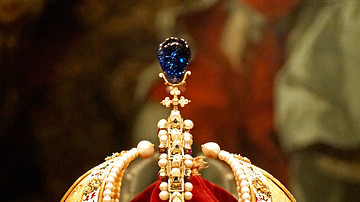
The Imperial Crown of Austria. Made in 1602, this crown has been used by the Habsburg monarchs of Austria, the Holy Roman Empire, and the Austro-Hungarian Empire, and the kings of Hungary and Bohemia. The crown combines the traditional crown...

Image Gallery
Faces of Roman Emperors: Imperial Crisis & the Barracks Emperors
A series of facial reconstructions of Roman emperors during the Crisis of the Third Century (235-284 CE), including the Gordian Emperors. These so-called "Barracks emperors" seized power during a time of turmoil, and their reigns were typically...
Image
Imperial Tsarevich Egg by Fabergé
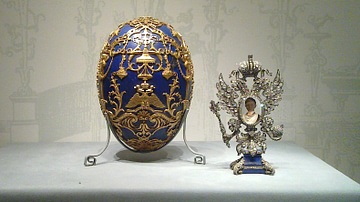
The 1912 Imperial Tsarevich Egg by Peter Carl Fabergé (1846-1920). The egg was given by Tsar Nicholas II (r. 1894-1917) to his wife Alexandra Feodorovna. The egg is made of gold and six lapis lazuli sections with diamond decoration. The latticework...

Image
Imperial Garden, Kaifeng
A detail of a silk scroll painting showing the imperial garden of Kaifeng, the first capital of the Song Dynasty (960-1279 CE). From 'Games in the Jinming Pool', by Chinese Song artist Zhang Zeduan (1085-1145 CE).

Image
Imperial Coronation Coach Egg by Fabergé
The 1897 Imperial Coronation Coach Egg by Peter Carl Fabergé (1846-1920). The egg was given by Tsar Nicholas II (r. 1894-1917) to his wife Alexandra Feodorovna. The egg is made of gold and yellow and black enamel. The trellis work has double-headed...
