
Search
Did you mean: Hurrians?
Remove Ads
Advertisement
Search Results

Definition
Nergal - The Mesopotamian God of Death, War, and Destruction
Nergal (also known as Erra and Irra) is the Mesopotamian god of death, war, and destruction. He began as a regional, probably agricultural, god of the Babylonian city of Kutha in the Sumerian...
Definition
Amarna Letters
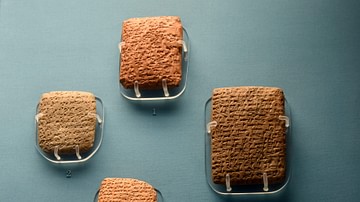
The Amarna Letters are a body of 14th-century BCE correspondence exchanged between the rulers of the Ancient Near East and Egypt. They are perhaps the earliest examples of international diplomacy while their most common subjects...

Definition
Hatti
The Hatti were an aboriginal people in central Anatolia (present-day Turkey) who first appeared in the area around the River Kizil Irmak. The prevailing understanding is that they were native to the land although it has been suggested...

Definition
Sumerian Language
The Sumerian language was spoken in southern Mesopotamia before the 2nd millennium BCE and was the first language to be written in the cuneiform script. It is an isolate language meaning we know of no other languages that relate...

Definition
Armenian Mythology
The mythology of ancient Armenia is a rich blend of indigenous traditions with imported ideas from neighbouring cultures and migrating peoples added over the centuries. The legends and stories helped to explain natural phenomena...
Definition
Arslan Tash Amulet
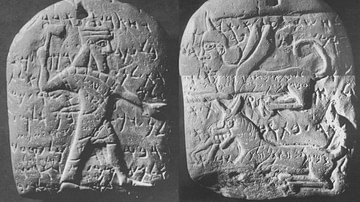
Dated to the 7th century BCE, the Arslan Tash amulet (AT1) was discovered in Arslan Tash, Syria and contains the writing of Phoenician, magic incantations. The limestone plaque includes a variety of features: incantations perceived...

Article
Libraries in the Ancient World
Libraries were a feature of larger cities across the ancient world with famous examples being those at Alexandria, Athens, Constantinople, Ephesus, and Nineveh. Rarely ever lending libraries, they were typically designed...

Image
Map of the The Mitanni (Hanigalbat) empire, c. 1600-1300 BCE - Between Egypt and the Hittites, A Kingdom of Diplomacy and War
The Mitanni Empire was a major Late Bronze Age power that rose in northern Mesopotamia and Upper Syria between c. 1600 and 1300 BCE, shaping...
Image
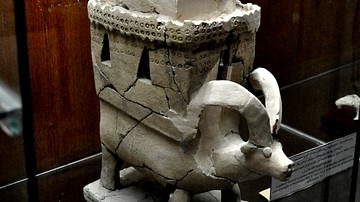
Mesopotamian Incense Container
A pottery incense container found at layer 5 of the altar platform of the central temple of Basmosian Hill, Mesopotamia, Hurrian period, 2nd millennium BCE.
Sulaimaniya Museum, Iraq.
Image
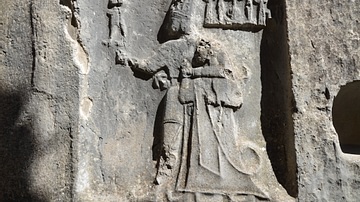
Hittite relief of the God Sharruma and King Tudhaliya
East wall of Chamber B of the Yazilikaya Hittite Rock Sanctuary near Hattusa (13th century BCE) depicting in a niche the God Sharruma (the Hurrian Mountain God and son of the Thunder God Teshub) embracing...
