
Search
Search Results
Image
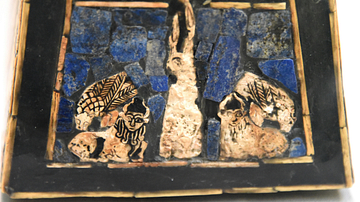
Human-Headed Bull in the Standard of Ur
This is one of the scenes depicted on one of the sides of the Standard of Ur; this is not part of the so-called "Peace and War Scenes" of the Standard. Here, at the center, there is what appears to be a tall tree, although its surface is...
Image
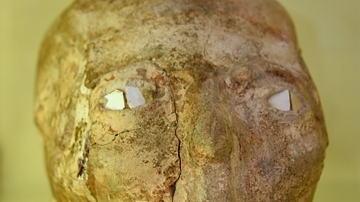
Plaster Model of Human Head
This human head and its face were modeled in plaster and the mouth area was filled in completely. The eye sockets were inlaid with bivalve shells, divided into two halves. Many human bodies were found headless in tombs in Jericho area from...

Video
Mummified Child Sacrifice
Working under a tight deadline, scientists extract samples that will help describe their young mummy's life.
Child Mummy Sacrifice : http://channel.nationalgeographic.com/episode/child-mummy-sacrifice-4084
Definition
Carthaginian Religion
Carthage was founded by the Phoenician city of Tyre in the 9th century BCE, and along with many other cultural practices, the city adopted aspects of the religion of its founding fathers. Polytheistic in nature, such important Phoenician...

Image
Nazca Line Human Figure
A Nazca geoglyph depicting a human figure. The designs and lines created on the desert floor of southern Peru are known collectively as the 'Nazca Lines' and were made over several centuries between 200 BCE and 500 CE. Their exact purpose...
Image
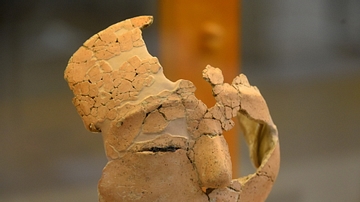
Plastered Face of a Human Skull from Ain Ghazal
This plastered face was modeled on a human skull and was buried with a group of similar plastered faces. This mode of skull decoration was probably related to some sort of ancestor cult. From modern-day Ain Ghazal, outskirts of Amman, Jordan...

Image
Title Page, Treatise of Human Nature
The title page of Treatise on Human Nature by the Scottish philosopher David Hume (1711-1776). A key text of the Enlightenment, it was first published in 1740. The quote from Tacitus reads: "It is the rare happiness of these days that one...

Image
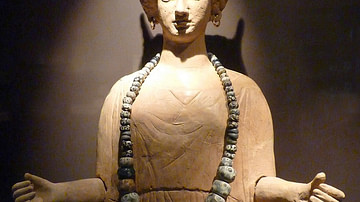
Lime Plaster Human Statue from Ain Al-Ghazal
This extraordinary statue is one of the earliest large-scale representations of the human form. It was found as part of a cache of up to 25 statues buried in a pit under the floor of an abandoned house. All of these statues have naturallistically...
Image
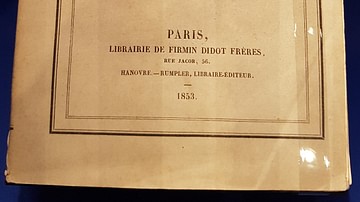
An Essay on the Inequality of the Human Races
Original edition of Arthur de Gobineau's (1816-1882 CE) An Essay on the Inequality of the Human Races. 1853 CE. Library of the National Museum of Natural History, Paris.
Image
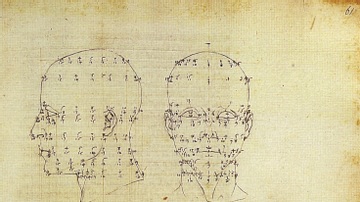
Drawing Showing Mathematical Perspective Applied to the Human Head by Piero della Francesca
A drawing by the Italian Renaissance artist Piero della Francesca (c. 1420-1492 CE) showing his theories of mathematical perspective applied to representing the human form. From De prospectiva pingendi.
