
Search
Did you mean: Horae?
Remove Ads
Advertisement
Search Results
Image
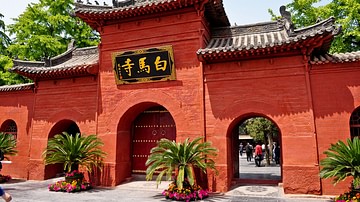
White Horse Temple
According to tradition, White Horse Temple, founded in 68 CE is the oldest Buddhist temple in China.
Image
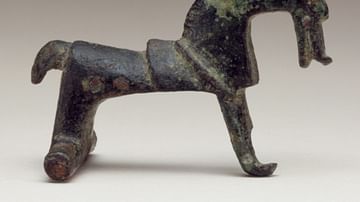
Celtic Horse Brooch
This small bronze brooch was made in Central Europe sometime between 650 and 550 BCE. This horse-shaped pin is one of many examples of Celtic animal brooches from Central Europe. From the Metropolitan Museum of Art, New York...
Image
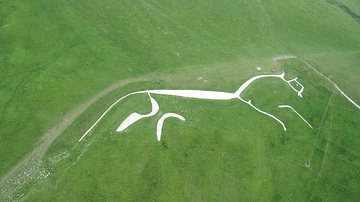
White Horse of Uffington
The white horse of Uffington, a Bronze Age carving into the chalk hills in Oxfordshire, England.
Image
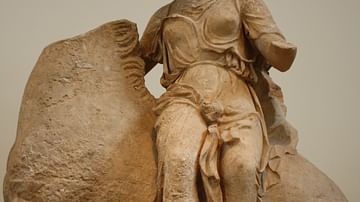
Nereid Rising from the Ocean on a Horse
A Nereid (or Aura) riding a horse as she rises from the Ocean. Pentelic marble, c. 380 BCE. By the sculptor Timotheos. (National Archaeological Museum, Athens).
Image
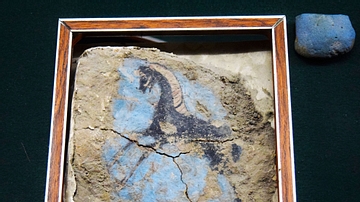
Urartian Horse Mural Fragment
This mural fragment of a running horse once adorned the large palace hall at Erebuni Fortress, which is located in present-day Yerevan, Armenia. It dates from roughly the 8th century BCE. (Erebuni Historical and Archaeological...
Image
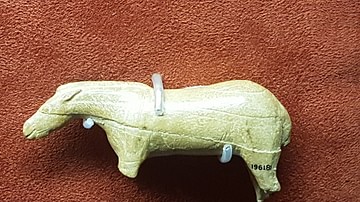
Magdalenian Horse Figurine
Cast of a horse figurine carved out of mammoth ivory belonging to the Magdalenian industry of the Upper Paleolithic, which is associated with early modern humans (Homo sapiens) in southwestern France between c. 17,000...
Image
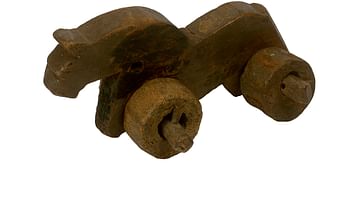
Byzantine Toy Horse
This wooden toy horse dates to the 4th to 5th century CE. Measures 14 cm in length. Photo © Bibliotheca Alexandrina Antiquities Museum/Photo by Emad Omar. Used by permission.
Image
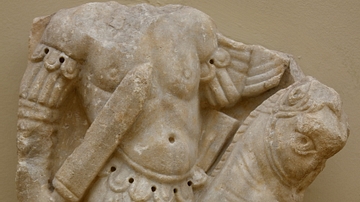
Relief of a Horse Rider from Balat
This rectangular marble piece depicts a horse rider advancing to the right. The upper body is encased in an armor (the shape of the armor fits the anatomical contours of the chest and upper abdomen). He holds a...
Image
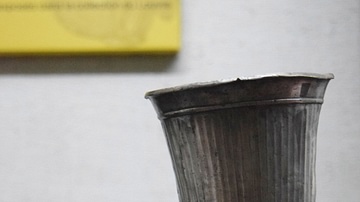
Persian Horse Head Rhyton
This is a horse head rhyton cast in silver, dating from the 5th century BCE when Armenia was under Persian control. It was found at the Erebuni Fortress in Yerevan, Armenia. (Erebuni Historical and Archaeological Preserve...
Image
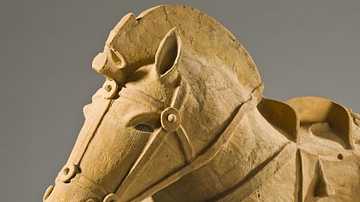
Haniwa Horse
A terracotta haniwa (tomb-marker) in the form of a horse. Asuka Period, 6th century CE, Japan. (Los Angeles County Museum of Art)
