
Search
Did you mean: Hermes?
Remove Ads
Advertisement
Search Results

Definition
Battle of the Granicus
The Battle of the Granicus in May 334 BCE was Alexander the Great's (356-323 BCE) first major victory against the forces of the Achaemenid Empire. Alexander had crossed the Hellespont with his combined Macedonian and Greek forces and stepped...

Definition
Parthian Cataphract
The Parthian cataphract was a heavy cavalry unit of Parthian warfare, an entirely armored, huge fast horse mounted by a completely armored rider, equipped with a long lance and a long sword. Like a modern tank designed to smash through enemy...
Definition
Roman Auxiliary Cavalry
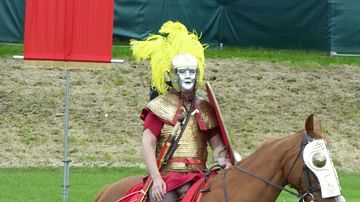
The Roman army consisted of three separate divisions: the famed legions, the cavalry, and lastly, the auxiliaries. The auxiliaries (auxilia) were comprised of infantry cohorts, mounted infantry, and cavalry units or wings (alae). Although...
Definition
Vetulonia
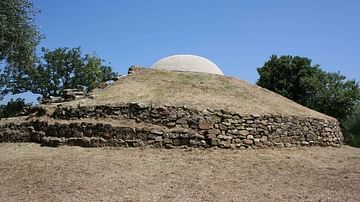
Vetulonia (Etruscan: Vetluna), located in the hills near the western coast of central Italy, was an important Etruscan town from the 9th to 3rd century BCE. The site has many impressive tumulus tombs which were rich in artefacts illustrating...

Article
Olmec Colossal Stone Heads
The stone head sculptures of the Olmec civilization of the Gulf Coast of Mexico (1200 BCE - 400 BCE) are amongst the most mysterious and debated artefacts from the ancient world. The most agreed upon theory is that, because of their unique...

Article
Beauty in the Bronze Age - Minoan & Mycenaean Fashion
Dress and appearance in Bronze Age Greece (c. 3100 BCE - c. 1100 BCE) played a part in defining gender roles and emphasising idealized beauty that planted the seed for modern-day standards. The Minoans turned the island of Crete into a Mediterranean...

Article
The Army of Alexander the Great
No military commander in history has ever won a battle by himself. To be successful he needs the support of a well-trained army who will follow him regardless of the cost whether it be a stunning victory or hopeless defeat. One need only...

Article
Norse-Viking Symbols & Meanings
A symbol is an image or object which represents an abstract concept, often having to do with one's religious beliefs. Every civilization, from the most ancient to the present, has made use of symbols to make the abstract concrete and visible...

Article
A Visual Who's Who of Greek Mythology
Achilles The hero of the Trojan War, leader of the Myrmidons, slayer of Hector and Greece's greatest warrior, who sadly came unstuck when Paris sent a flying arrow guided by Apollo, which caught him in his only weak spot, his heel. Adonis...

Article
The Women of Athena's Cult
In ancient Athens, women had no life outside the home unless they were prostitutes or were engaged in religious activities such as festivals. Every Greek deity in every city-state had their own cult (sect) but the cult of Athena offered women...
