
Search
Did you mean: Heka?
Remove Ads
Advertisement
Search Results

Definition
Nihon Shoki
The Nihon Shoki ('Chronicle of Japan' and also known as the Nihongi) is an official history of Japan which was written by a committee of court scholars in 720 CE. It is a compilation of myths and legends concerning the Shinto gods and episodes...

Definition
Kinkakuji
Kinkakuji Temple in Kyoto, Japan, more formally referred to as Rokuon-ji or 'Deer Garden Temple' and otherwise known as 'The Temple of the Golden Pavilion', was first built in 1397 CE. Originally the retirement residence of the shogun Ashikaga...

Definition
Ancient Nara
Nara, located around 30 km south of modern Kyoto, was the capital of ancient Japan between 710 and 784 CE. It gave its name to the Nara Period (710-794 CE), although the name during the 8th century CE was Heijokyo. Modelled on the Chinese...
Definition
Itsukushima Shrine
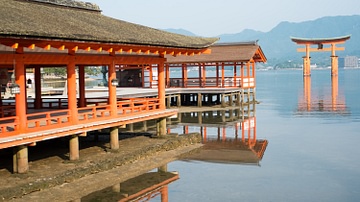
Itsukushima Shrine is a Shinto shrine on the island of the same name, also known as Miyajima, located in Hatsukaichi, Hiroshima Prefecture, Japan. Traditionally founded in the 6th century CE, the present layout of buildings dates to the 12th...

Definition
Ihara Saikaku
Ihara Saikaku (1642-1693) was a Japanese poet and novelist who played a leading role in creating the so-called ‘floating world’ (ukiyo-zoshi) genre of popular literature in the 17th century. His work was significant because, in terms of both...

Definition
Todaiji
Todaiji is an ancient temple complex in Nara, Japan. Founded in 738 CE and officially opened in 752 CE when Nara was the capital, the temple is the headquarters of the Buddhist Kegon sect. The temple has a 500-ton sculpture of the Buddha...

Definition
Chushingura
Kanadehon Chushingura (A Treasury of Loyalty of Loyal Retainers or The Story of the Forty-Seven Samurai) is the most popular play in the history of Japanese theatre, first performed in 1748. It is a work of fiction, but the details of the...
Definition
Ennin
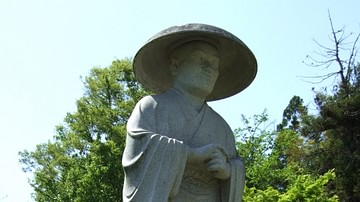
Ennin (c. 793-864 CE, posthumous title: Jikaku Daishi) was a Japanese Buddhist monk of the Tendai sect who studied Buddhism at length in China and brought back knowledge of esoteric rituals, sutras, and relics. On his return, he published...

Article
Feudalism in Medieval Japan
Feudalism in medieval Japan (1185-1603) is the relationship between lords and vassals where land ownership and its use were exchanged for military service and loyalty. Although present earlier to some degree, the feudal system in Japan was...

Article
A Traditional Japanese House
The traditional house of ancient and medieval Japan (1185-1606 CE) is one of the most distinctive contributions that country has made to world architecture. While the rich and powerful might have lived in castles and villas, and the poor...
