
Search
Did you mean: Hebe?
Remove Ads
Advertisement
Search Results

Article
The Origin of Satan
Satan, or the Devil, is one of the best-known characters in the Western traditions of Judaism, Christianity, and Islam. Surprisingly, this entity was a late-comer in the ancient world. Satan, as a totally evil being, is nowhere to be found...

Article
The Admonitions of Ipuwer - A Tale of Chaos and the Importance of Government
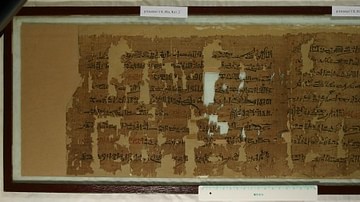
The Admonitions of Ipuwer (also known as The Papyrus Ipuwer and The Admonitions of an Egyptian Sage) is a literary text dated to the Middle Kingdom of Egypt (2040-1782 BCE). The only extant copy of the work, preserved on the Papyrus Leiden...

Article
The Queen of the Night
The Queen of the Night (also known as the `Burney Relief') is a high relief terracotta plaque of baked clay, measuring 19.4 inches (49.5 cm) high, 14.5 inches (37 cm) wide, with a thickness of 1.8 inches (4.8 cm) depicting a naked winged...

Article
Thutmose III at The Battle of Megiddo
The ancient site of Megiddo was the scene of a number of battles in antiquity and is best known as the source of the word armageddon, the Greek rendering of the Hebrew Har-Megiddo ('Mount of Megiddo') from the biblical Book of Revelation...
Article
The Satire of the Trades
The literature of ancient Egypt is as rich and varied as any other culture. From the inscriptions of the Old Kingdom of Egypt (c. 2613-2181 BCE) through the Love Poems of the New Kingdom (c. 1570 - c. 1069 BCE) the Egyptian scribes produced...

Article
Angels in Ancient Judaism
The concept and function of angels in ancient Judaism were some of the many elements incorporated from contemporary cultures and religious views. The Hebrew malakh was translated into the Greek angelos, both of which indicated not their nature...

Article
Old Testament Pseudepigrapha
The Old Testament Pseudepigrapha are the non-canonical writings of Judaism and Christianity, ranging from the 5th century BCE to the 9th century CE. Pseudepigrapha comes from a Greek noun denoting writings with a false superscription or name...

Article
Nativity of Jesus
The nativity of Jesus of Nazareth is told in the gospels of Matthew and Luke. In Christian theology, the existence of two nativity stories by two different writers provided a prooftext for the historicity of the event. However, the two versions...

Article
The Divinity of Jesus
In the decades of the 20s and 30s of the 1st century CE, a Jew from the town of Nazareth in the Galilee began preaching that the God of Israel would soon intervene in history, restoring that nation to God's original plan and glory. From this...
Image
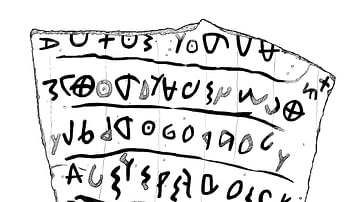
Khirbet Qeiyafa Ostracon
An illustration showing the markings of an ostracon (pottery sherd) from Khirbet Qeiyafa, Israel. The sherd is cited as evidence that the Hebrew language was in use from the 10th century BCE. The text has been interpreted as a social statement...
