
Search
Remove Ads
Advertisement
Search Results

Definition
Neo-Assyrian Empire
The Neo-Assyrian Empire (912-612 BCE) was the final stage of the Assyrian Empire, stretching throughout Mesopotamia, the Levant, Egypt, Anatolia, and into parts of Persia and Arabia. Beginning with the reign of Adad Nirari II (912-891 BCE...

Definition
Sargonid Dynasty
The Sargonid Dynasty was the last ruling house of the Neo-Assyrian Empire from 722-612 BCE, beginning with the reign of Sargon II and ending with fall of the Neo-Assyrian Empire. Some of the most famous kings in the history of Assyria come...

Article
A Traditional Japanese House
The traditional house of ancient and medieval Japan (1185-1606 CE) is one of the most distinctive contributions that country has made to world architecture. While the rich and powerful might have lived in castles and villas, and the poor...

Article
The Banquet Stele of Ashurnasirpal II
When he came to the throne in 884 BCE, Ashurnasirpal II had to attend to revolts which broke out across the empire. He ruthlessly put down all rebellions, destroyed the rebel cities and, as a warning to others, impaled, burned, and flayed...

Article
Herod the Great's Building Program
Herod the Great was the king of Judea from 37-4 BCE. As a client king of Rome, Herod's moniker as "Great" was due more to his grand building program throughout the eastern Mediterranean world. Herod's building program generally ran from 35...

Definition
Sumerians - Inventors of Civilization
The Sumerians were the people of southern Mesopotamia (modern-day southern Iraq) whose civilization flourished between circa 4000 and 1750 BCE. Their name comes from the region, which is frequently – and incorrectly – referred to as a "country."...

Definition
Hercules
Hercules (Herakles) was a hero of Greek mythology famous for his great strength and endurance. Celebrated as an extraordinary mortal, his success in seemingly impossible labours won him an immortal place amongst the gods. As the greatest...

Definition
Idunn
Idunn (pronounced Ih-dune) is a fertility goddess in Norse mythology who holds the apples of eternal youth the gods rely on to remain young and healthy. The Norse gods were not immortal – they just lived very long lives – and the apples of...
Image
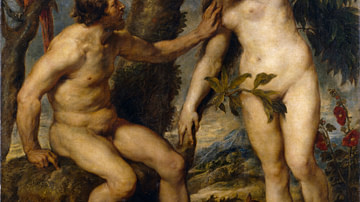
Adam & Eve
Adam and Eve by Peter Paul Rubens (1577-1640 CE). (Prado Museum, Madrid)

Image Gallery
Reconstructions of the Seven Wonders of the Ancient World
This collection features reconstructions of the Seven Wonders of the Ancient World; from the Hanging Gardens of Babylon to the Colossus of Rhodes. Out of the Seven Wonders, only one is still standing today - albeit in a damaged state - the...
