
Search
Remove Ads
Advertisement
Search Results

Definition
English Reformation
The English Reformation began with Henry VIII of England (r. 1509-1547 CE) and continued in stages over the rest of the 16th century CE. The process witnessed the break away from the Catholic Church headed by the Pope in Rome. The Protestant...

Definition
Kingdom of Israel
The Kingdom of Israel occupied that part of the land on the Mediterranean Sea known as the Levant which corresponds roughly to the State of Israel of modern times. The region was known, historically, as part of Canaan, as Phoenicia, as Palestine...

Definition
Baal
Baal (also given as Ba'al) is a Canaanite-Phoenician god of fertility and weather, specifically rainstorms. The name was also used as a title, however, meaning "Lord" and was applied to a number of different deities throughout the ancient...

Definition
Council of Trent
The Council of Trent (1545-1563) was a meeting of Catholic clerics convened by Pope Paul III (served 1534-1549) in response to the Protestant Reformation. In three separate sessions, the council reaffirmed the authority of the Catholic Church...

Definition
Eridu Genesis
The Sumerian Flood Story (also known as the Eridu Genesis, The Flood Story, Sumerian Creation Myth, Sumerian Deluge Myth) is the oldest Mesopotamian text relating the tale of the Great Flood which would appear in later works such as the Atrahasis...
Definition
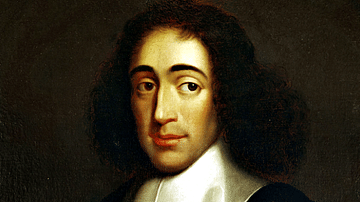
Baruch Spinoza
Baruch Spinoza (1632-1677) was a Dutch philosopher who combined rationalism and metaphysics to create a unique system of thought. Spinoza was held up as an atheist philosopher in the 18th century, but this is not an entirely accurate representation...

Definition
Mesrop Mashtots
Mesrop Mashtots (360/370 - c. 440 CE) invented the Armenian alphabet in 405 CE. Besides greatly increasing levels of literacy in the country, the language permitted ordinary people to read the Bible for the first time, thus helping to further...

Definition
Cardinal Thomas Cajetan
Cardinal Thomas Cajetan (l.c. 1468-1534) was a Catholic theologian and philosopher best known for his disputations with Martin Luther (l. 1483-1546) beginning in 1518. Cajetan, a philosophical Humanist, was thought to have had the best chance...

Article
Old Testament Pseudepigrapha
The Old Testament Pseudepigrapha are the non-canonical writings of Judaism and Christianity, ranging from the 5th century BCE to the 9th century CE. Pseudepigrapha comes from a Greek noun denoting writings with a false superscription or name...

Definition
Nineveh - The Great Cultural Center That Became the "City of Sin"
Nineveh (modern-day Mosul, Iraq) was one of the oldest and greatest cities in antiquity. It was originally known as Ninua, a trade center, and would become one of the largest and most affluent cities in antiquity. It was regarded highly by...
