
Search
Search Results

Definition
Greek Mythology
Greek mythology was used as a means to explain the environment in which humankind lived, the natural phenomena they witnessed and the passing of time through the days, months, and seasons. Greek myths were also intricately connected to religion...

Definition
Ancient Greek Medicine
In ancient Greek medicine illness was initially regarded as a divine punishment and healing as, quite literally, a gift from the gods. However, by the 5th century BCE, there were attempts to identify the material causes for illnesses rather...

Article
The Art of the Amarna Period
Of all the pharaohs who ruled ancient Egypt, there is one in particular that stands out from the rest. Over the course of his 17-year reign (1353-1336 BCE), Akhenaten spearheaded a cultural, religious, and artistic revolution that rattled...
Article
The Early Three Kingdoms Period
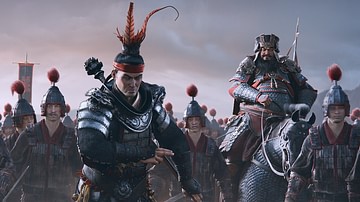
The Early Three Kingdoms Period in ancient China, from 184 CE to 190 CE for the purposes of this article, was one of the most turbulent in China's history. With an ailing Han government unable to control its empire, brutal localised wars...
Image
Cypro-Archaic Sculptures
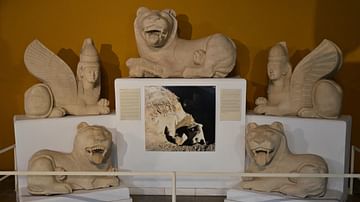
Five unique Cypro-Archaic sculptures found in situ in the necropolis of Talmassos, one oversize lion, two lions of smaller dimensions and two sphinxes. 6th century BCE (Cypro-Archaic II period). Cyprus Museum, Nicosia.
Article
Some new hypotheses on the problems of the Indo-Greek kingdoms
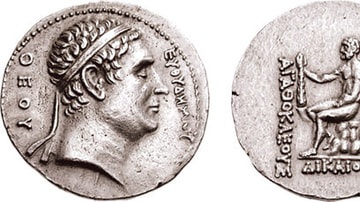
Warning: See the definitions of Greco-Bactrian and Indo-Greek Kingdoms before reading this article, otherwise the following lines could give you serious headaches! A lack of information is a common problem for historians of the Greco-Bactrian...

Image
Clay tablet from the Archaic Buildings of Ishtar Temple
This clay tablet lists the names of certain persons with their corresponding official designation. The Archaic buildings of the Ishtar Temple were in use from 2500-2000 BCE. From the Archaic temples (or buildings) of Ishtar at the city of...
Image
Votive Statuette from the Archaic Buildings of the Ishtar Temple
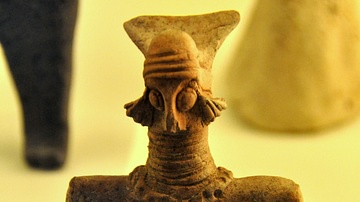
Only the upper half of this small female terracotta statuette has survived. The woman wears a hat and a necklace and covers her naked breasts with her hands. The Archaic buildings of the Ishtar Temple were in use from 2500-2000 BCE. From...
Image
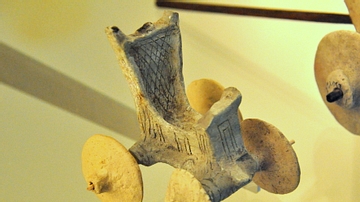
Votive Toy from the Archaic Buildings of the Ishtar Temple
This small terracotta toy in the shape of a wagon was a votive donation to the goddess Ishtar. The Archaic buildings of the Ishtar temple were in use from 2500-2000 BCE. From the Archaic temples (or buildings) of Ishtar at the city of Ashur...
Article
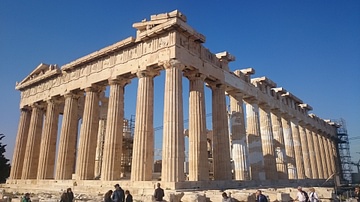
Greek World Heritage Sites
Greece, the 'cradle of western civilization', is home to a large number of spectacular sites from the ancient world, several of which have been placed on the UNESCO World Heritage List. These sites of great historical importance, interest...
