
Search
Remove Ads
Advertisement
Search Results

Image
Representatives of the Five Civilized Tribes
Representatives of the Five Civilized Tribes: (clockwise from upper left) Sequoyah of the Cherokee, Pushmataha of the Choctaw, Selecta of the Muscogee Creek, Osceola of the Seminole, and a typical Chickasaw...

Image
The Five Fires, Khajuraho
A broken sculpture of the five kinds of fire. Hunger is in the foreground. It bites like a scorpion. It is surrounded by the other four fires: greed, envy, lust, and anger. The fire are all skeletal; their ribs show through...
Image
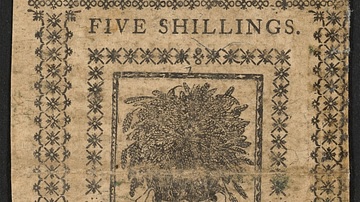
Five Shillings from Colonial Delaware
A Delaware bill worth five shillings. The bottom caption reads: "To Counterfeit is Death". Minted in Delaware by James Adam (1724-1792 CE) under the authority of George III of Great Britain and Ireland (r. 1760–1820...

Definition
Roman Imperial Cult
The Roman imperial cult was the practice of venerating Roman emperors and their families as having divine attributes, honoring their contributions to the spread of Roman religion and culture. It was instituted by the first...

Definition
Western Roman Empire
The Western Roman Empire is the modern-day term for the western half of the Roman Empire after it was divided in two by the emperor Diocletian (r. 284-305 CE) in c. 285/286 CE. The Romans themselves did not use this term...

Video
Life of Emperor Nerva #12 First of the Best Emperors
Emperor Nerva is the first of the 'Five Good Emperor'. However, his reign proved to be fairly lackluster and he only reigned for 15 months and during his short time on the throne, his Praetorian Guards...

Article
Enemies of Rome in the 3rd Century CE - The Greatest Enemy of Rome was Rome Itself
It has been said that the greatest enemy of Rome was Rome itself, and this is certainly true of the period known as the Crisis of the Third Century (also known as the Imperial...

Definition
Roman Empire
The Roman Empire, at its height (c. 117), was the most extensive political and social structure in western civilization. Building upon the foundation laid by the Roman Republic, the empire became the largest and most powerful political...

Definition
Byzantine Emperor
The Byzantine Emperor ruled as an absolute monarch in an institution which lasted from the 4th to 15th century CE. Aided by ministers, high-ranking nobility, and key church figures, the emperor (and sometimes empress) was commander-in-chief...

Definition
Treaties of Tilsit
The Treaties of Tilsit were two peace treaties signed in July 1807 by Emperor Napoleon I of France (r. 1804-1814; 1815) and the monarchs of Russia and Prussia in the aftermath of the Battle of Friedland. The treaties ended the...
