
Search
Remove Ads
Advertisement
Search Results

Definition
Jesus Christ
Jesus Christ is the designation of Jesus of Nazareth (d. c. 30 CE), who was an itinerant Jewish prophet from Galilee in northern Israel. He preached the imminent intervention in human affairs by the God of the Jews, when God would...

Definition
Ur - The Great Biblical City Abandoned by the Gods
Ur was a city in the region of Sumer, in southern Mesopotamia, and its ruins lie in what is modern-day Tell el-Muqayyar, Iraq. According to biblical tradition, the city is named after the man who founded...
Definition
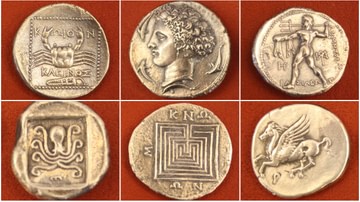
Ancient Greek Coinage
The coinage of ancient Greece has given us some of the most recognisable images from antiquity as they were stamped with designs to proudly declare the identity of the city which minted them and guarantee their value. One...

Definition
Poulnabrone
Poulnabrone is a portal tomb in the region known as the Burren, County Clare, Ireland and the oldest dated megalithic monument in the land. The name means "Hole of the Quern Stones", but the site is also commonly referred to as "Hole...

Definition
Yayoi Period
The Yayoi Period is one of the oldest historical periods of Japan spanning from c. 300 BCE to c. 250 CE, preceded by the Jomon Period and followed by the Kofun Period. The name Yayoi comes from the district in Tokyo where the first...

Definition
Ancient Egyptian Government
The government of ancient Egypt was a theocratic monarchy as the king ruled by a mandate from the gods, initially was seen as an intermediary between human beings and the divine, and was supposed to represent the gods'...

Definition
Chang'an
Chang'an, located near modern Xian in Shaanxi Province, was the capital of several dynasties of ancient China from the Zhou to the Tang and eventually became one of the world's great metropolises. With regular tree-lined avenues, high...

Definition
Vikings
The Vikings were originally diverse Scandinavian seafarers from Norway, Sweden, and Denmark (though other nationalities were later involved) whose raids and subsequent settlements significantly impacted the cultures of Europe and were...

Definition
The Eumenides
The Eumenides is a play written by Aeschylus (c 525 – 455 BCE), the “Father of Greek Tragedy,” the most popular and influential of all tragedians of his era. The Eumenides was the third play of a trilogy, The Oresteia, with the...

Definition
Elizabethan Theatre
Elizabethan theatre, sometimes called English Renaissance theatre, refers to that style of performance plays which blossomed during the reign of Elizabeth I of England (r. 1558-1603) and which continued under her Stuart successors...
