
Search
Remove Ads
Advertisement
Search Results

Definition
Plato
Plato (l. 424/423 to 348/347 BCE) is the pre-eminent Greek philosopher, known for his Dialogues and for founding his Academy in Athens, traditionally considered the first university in the Western world. Plato was a student of Socrates...

Definition
Carthaginian Army
The armies of Carthage permitted the city to forge the most powerful empire in the western Mediterranean from the 6th to 3rd centuries BCE. Although by tradition a seafaring nation with a powerful navy, Carthage, by necessity...

Definition
Lascaux Cave
Lascaux Cave is a Palaeolithic cave situated in southwestern France, near the village of Montignac in the Dordogne region, which houses some of the most famous examples of prehistoric cave paintings. Close to 600 paintings – mostly...
Definition
Edessa
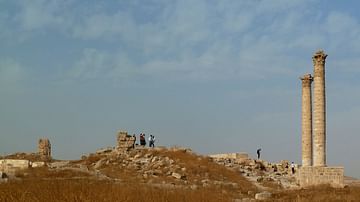
Edessa (modern Urfa), located today in south-east Turkey but once part of upper Mesopotamia on the frontier of the Syrian desert, was an important city throughout antiquity and the Middle Ages. A city within the Seleucid Empire, then...

Definition
Todaiji
Todaiji is an ancient temple complex in Nara, Japan. Founded in 738 CE and officially opened in 752 CE when Nara was the capital, the temple is the headquarters of the Buddhist Kegon sect. The temple has a 500-ton sculpture of the Buddha...

Definition
Agamemnon (Person)
Agamemnon was the legendary king of Mycenae and leader of the Greek army in the Trojan War of Homer's Illiad. Agamemnon is a great warrior but also a selfish ruler who famously upset his invincible champion Achilles, a feud...

Definition
Abd al-Rahman III
Abd al-Rahman III was an Umayyad prince who reigned as Emir of Cordoba, and later Caliph of Cordoba, from 912 to 961 CE. His reign is remembered as a golden age of Muslim Spain and Umayyad rule, epitomized by his declaration...

Definition
Electra by Euripides
Electra is a Greek tragedy written by the playwright Euripides, c. 420 BCE. It retells the classic myth concerning the plotting of Electra and her brother Orestes to kill their mother and her lover. This version of the story...
Definition
Etymologiae
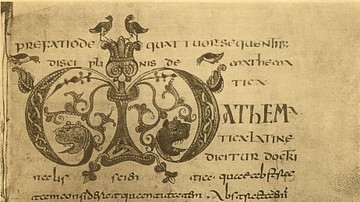
The Etymologiae (Etymologies) is a Latin work by Isidore of Seville (l. c. 560 - 636 CE), compiled in the early 7th century CE and published in its final form shortly after his death. The book is a type of medieval encyclopedia and...

Definition
Raphael
Raphael (1483-1520) was an Italian painter and architect who is regarded as one of the greatest of Renaissance artists alongside Michelangelo (1475-1564) and Leonardo da Vinci (1452-1519). Raphael's works are celebrated for their harmonious...
