
Search
Remove Ads
Advertisement
Search Results

Definition
Garden of Eden
The Garden of Eden is the biblical earthly paradise created by God to be inhabited by his first human creation - Adam and Eve. Some claim that the name “Eden” derives from the Akkadian term edinu, which means 'plain'. In the biblical...

Definition
Zenobia
Zenobia (b. c. 240 CE, death date unknown) was the queen of the Palmyrene Empire who challenged the authority of Rome during the latter part of the period of Roman history known as The Crisis of the Third Century (235-284 CE also known...
Definition
Commagene
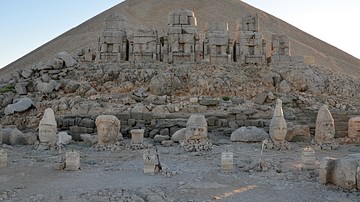
The Kingdom of Commagene (163 BCE - 72 CE) was a Hellenistic political entity, heavily influenced by Armenian and ancient Persian culture and traditions, established in southwestern Anatolia (modern-day Turkey) by Ptolemaeus of Commagene...

Article
The Mesopotamian Pantheon - The Ancient Gods and Goddesses of the Near East
The gods of the Mesopotamian region were not uniform in name, power, provenance or status in the hierarchy. Mesopotamian culture varied from region to region and, because of this...

Article
12 Great Cities of Ancient Mesopotamia - The Rise and Fall of the Earliest Cities in the World
The great cities of Mesopotamia ("the land between two rivers") developed prior to the late 4th millennium BCE along two rivers – the Tigris and Euphrates – and were...

Article
The Legend of Sargon of Akkad - Inspiration for the Story of Moses
The Legend of Sargon of Akkad (circa 2300 BCE) is an Akkadian work from Mesopotamia understood as the autobiography of Sargon of Akkad (Sargon the Great, reign 2334-2279 BCE), founder of...
Article
The Eastern Trade Network of Ancient Rome
The life of wealthy Romans was filled with exotic luxuries such as cinnamon, myrrh, pepper, or silk acquired through long-distance international trade. Goods from the Far East arrived in Rome through two corridors...

Article
Gilgamesh, Enkidu, and the Netherworld
Gilgamesh, Enkidu, and the Netherworld is a Sumerian poem pre-dating The Epic of Gilgamesh and featuring its central characters. It is sometimes included in modern-day translations as Book 12 but is usually omitted...

Article
Inanna and Su-kale-tuda - An Ancient Condemnation of the Crime of Rape
Inanna and Su-kale-tuda (circa 1800 BCE) is a Mesopotamian myth dealing with rape and justice in ancient Sumer. The work has been interpreted as an astral myth or a figurative account...

Article
Hadrian's Travels
No other Roman emperor travelled as much as Hadrian (r. 117-138 CE). The 'restless' emperor spent more time travelling than in Rome, devoting half of his 21-year reign to the inspection of the provinces. His travels provided...
