
Search
Did you mean: Eris?
Remove Ads
Advertisement
Search Results

Definition
Kabbalah
The term Kabbalah refers specifically to the form of Jewish mysticism that became widespread in the Middle Ages. However, in recent decades it has essentially become a generic term for the entirety of Jewish mystical thought. Literally...
Definition
Harpy
A harpy, also known as a harpyia (pl. harpyiai), is a part-bird, part-woman monster in Greek mythology. Known as the 'Hounds of Zeus,' they were the personification of storm winds and were under the command of Zeus, who would send them...

Definition
Neptune
Neptune is the Roman god of the sea and the Roman equivalent of the Greek god Poseidon. He was originally a god of fresh water and became associated with Poseidon early on in Roman history. He lives in a golden palace at the bottom of...

Definition
Christopher Marlowe - Poet, Playwright, Spy
Christopher Marlowe (1564-1593), or Kit Marlowe, was a poet and playwright of the English Renaissance who wrote during the Elizabethan Era (1558-1603). His mastery of the blank verse – unrhymed iambic pentameter...
Definition
Nehushtan
According to the Bible, Nehushtan was a metal serpent mounted on a staff that Moses had made, by God's command, to cure the Israelites of snake bites while wandering in the desert. The symbol of snakes on a staff or pole is a motif...
Definition
Catullus
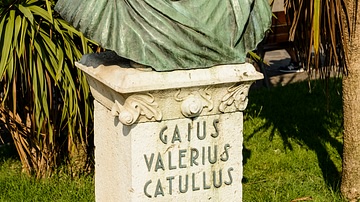
Gaius Valerius Catullus (84-54 BCE) was a Roman poet whose poems are considered to be some of the finest examples of lyric poetry from ancient Rome, despite his youth and early death. Catullus wrote in the neoteric style during the...

Definition
Spanish Galleon
The Spanish galleon (Spanish: galeón, nao, or navío) was a particularly large type of galleon used for both carrying cargo and as a warship armed with up to 60 cannons. Used from the mid-16th century until the early 19th century...

Definition
Manila Galleon
The Manila galleons were Spanish treasure ships which transported precious goods like silk, spices, and porcelain from Manila in the Philippines to Acapulco, Mexico, between 1565 and 1815. The Atlantic treasure fleets then shipped...

Definition
Zephyrus
Zephyrus was the god of the west wind and the messenger of spring in Greek mythology. He was known as one of the four Anemoi, or wind gods, each of whom represented a cardinal direction and, except for Eurus, a season. Zephyrus was...

Definition
Mycenaean Civilization
The Mycenaean civilization flourished in the Late Bronze Age (c. 1700-1100 BCE), peaking from the 15th to the 13th century BCE. The Mycenaeans extended their influence throughout the Peloponnese in Greece and across the Aegean...
