
Search
Remove Ads
Advertisement
Search Results

Article
Royal Women in the Mughal Empire
It was not only the Mughal emperors that left an indelible mark in the history of the Indian subcontinent but also the queens and princesses. The latter's contributions to art, architecture, literature, cuisine, refinement...
Article
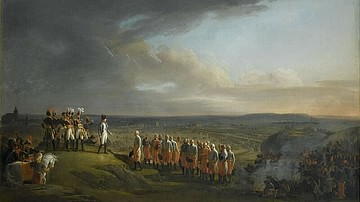
Ulm Campaign
The Ulm Campaign (25 September to 20 October 1805) was a military operation during the War of the Third Coalition (1805-1806). Through a series of maneuvers, the 210,000 men of the French Grande Armée, led by Emperor Napoleon I...

Article
Zenobia's Rebellion in the Historia Augusta
The Historia Augusta (Great History) is a Latin work of the 4th century CE that chronicles the lives of Roman emperors from 117-285 CE. Among the many stories related is the history of Zenobia of Palmyra...

Article
Religion in Ancient China
Religious practices in ancient China go back over 7,000 years. Long before the philosophical and spiritual teachings of Confucius and Lao-Tzu developed or before the teachings of the Buddha came to China, the people worshipped...

Article
The Integration of Church and State in the Roman Empire
In the ancient world, "religion" and society were not separate entities. Various gods dictated covenants, "law-codes," and social conventions. Such law-codes were most often the responsibility of...

Article
Women in the Byzantine Empire
Women in the Byzantine Empire (4th to 15th century CE) were, amongst the upper classes, largely expected to supervise the family home and raise children while those who had to work for a living did so in most of the...

Article
The Dragon in Ancient China
Dragons appear in the mythology of many ancient cultures but nowhere else in the world was the creature quite so revered as in China. There, in marked contrast to other world mythologies, the dragon was almost always...

Article
1453: The Fall of Constantinople
The city of Constantinople (modern Istanbul) was founded by Roman emperor Constantine I in 324 CE and it acted as the capital of the Eastern Roman Empire, or Byzantine Empire as it has later become known, for well...

Definition
Roman Coinage
Roman coins were first produced in the late 4th century BCE in Italy and continued to be minted for another eight centuries across the empire. Denominations and values more or less constantly changed but certain types such as the...

Definition
Tsar
Tsar (also czar) is a Slavic term derived from the Latin caesar. Ivan III (Ivan the Great) (r. 1462-1505) was the first Russian ruler to begin using the title of tsar during his reign instead of the title Grand Prince of Moscow. His grandson...
