
Search
Remove Ads
Advertisement
Search Results

Definition
Cniva - The Goth King Who Defeated Rome
Cniva (also given as Kniva, reign circa 250 to possibly 270) was the king of the Goths who defeated Emperor Decius (reign 249-251) at the Battle of Abritus in 251. Little is known of him other than his campaign in 251, in which he successfully...

Definition
Ancient Japan
Ancient Japan has made unique contributions to world culture which include the Shinto religion and its architecture, distinctive art objects such as haniwa figurines, the oldest pottery vessels in the world, the largest wooden buildings anywhere...

Definition
Claudius - The Unlikely Roman Emperor
Claudius (10 BCE to 54 CE) was the fourth Roman emperor, who reigned from 41 to 54 CE. Though a member of the imperial Julio-Claudian Dynasty, his rise to power had always seemed unlikely. Indeed, for much of his life, he had been ostracized...

Definition
Maximinus Thrax
Maximinius Thrax ruled briefly as the Roman emperor from 235 CE to his death in 238 CE. The young Roman Emperor Alexander Severus secured the imperial throne after the assassination of his cousin Elagabalus by the Praetorian Guard in 222...

Article
Enemies of Rome in the 3rd Century CE - The Greatest Enemy of Rome was Rome Itself
It has been said that the greatest enemy of Rome was Rome itself, and this is certainly true of the period known as the Crisis of the Third Century (also known as the Imperial Crisis, 235-284). During this time of almost 50 years, over 20...

Image
The Hongwu Emperor
The Hongwu Emperor, the first emperor of the Ming Dynasty (1368 to 1644 CE) who reigned from 1368 to 1398 CE. 14th century CE painted silk hanging. (National Palace Museum, Taipei)

Image
Emperor Taizu
A 10th century portrait on a hanging silk scroll of Taizu, first emperor of the Song dynasty in China, r. 960-976. The extensions on the emperor's black gauze cap symbolise his power and dignity.
National Palace Museum, Taipei.

Definition
Frederick II
Frederick II (l. 1194-1250 CE) was the king of Sicily (r. 1198-1250 CE), Germany (r. 1215-1250 CE), Jerusalem (r. 1225-1228 CE), and also reigned supreme as the Holy Roman Emperor (r. 1220-1250 CE). He was born in Jesi in 1194 CE but spent...

Definition
Vespasian - The Commoner Who Became Roman Emperor
Vespasian (9-79 CE) was Roman emperor from 69 to 79 CE. Despite his low birth, he worked hard to rise through the ranks of Roman politics and eventually achieved prominence as a military commander. He came to power at the end of the brief...
Definition
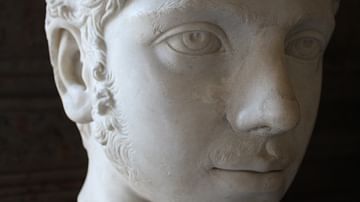
Elagabalus
Elgabalus was Roman emperor from 218 to 222 CE. Having failed to keep many of his promises to the army, Roman Emperor Macrinus (217 – 218 CE) was becoming increasingly unpopular, and it would only take a little lie from a young boy's mother...
