
Search
Remove Ads
Advertisement
Search Results
Image
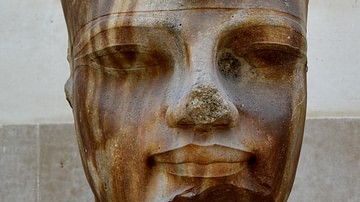
Pharaoh Amenhotep III
This is a quartzite head of the Egyptian pharaoh Amenhotep III; the king wears the red crown of Lower Egypt. This style is very typical of the sculpture of Amenhotep III, especially in the depiction of the eyes. It also foreshadows...

Article
Conflict Between the Temple and the Crown in Ancient Egypt
The gods of ancient Egypt were worshipped as the creators and sustainers of all life. People acknowledged their supremacy and intimacy daily through rituals, amulets, and their labor for the king...

Image
Pharaoh Akhenaten, Cairo Museum
A small bust of Akhenaten (r. 1353-1336 BCE), pharaoh of Egypt in the 18th Dynasty. He is wearing the crown of Egypt.
Cairo Museum.
Image
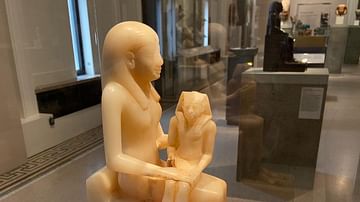
Queen Ankhnes-meryre II & Pharaoh Pepi II
This alabaster statue of Pharaoh Pepi II (2284 - c. 2216 BCE) and his mother, is one of the more famous representations of the two because the statue technically has two “front” sides. By placing Pepi II and...
Image
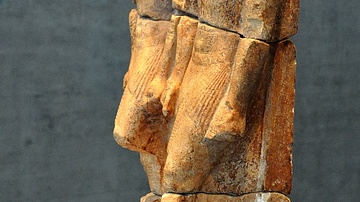
Pharaoh Niuserre
Calcite double statue of the Egyptian pharaoh Niuserre (also written Nyuserre Ini, Neuserre Izi, or Niuserre Isi). He stands and strides. The pharaoh is depicted as an old man and a young man. From modern-day Egypt. Old Kingdom...

Image
Pharaoh, Book of the Dead
A detail from the Book of the Dead of Tayesnakht from Thebes, Ptolemaic Period, 332-30 BCE. Pharaohs often wore two crowns to signify the unification of Lower and Upper Egypt. (Egyptian Museum, Turin)

Definition
Ergamenes
King Ergamenes (also known as King Arkamani I, r. 295-275 BCE) was the greatest king of the city of Meroe, Kingdom of Kush (located in modern-day Sudan) who broke free from Egyptian dominance to help direct a wholly distinct culture...

Definition
Seshat
Seshat (also given as Sefkhet-Abwy and Seshet) is the Egyptian goddess of the written word. Her name literally means "female scribe" and she is regularly depicted as a woman wearing a leopard skin draped over her robe with a headdress...
Image
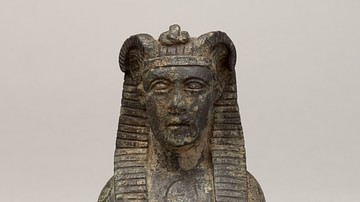
Bust of Alexander as Pharaoh
Copper alloy bust of Alexander wearing a nemes headdress. From Egypt, c. 150 BCE to 200 CE.
Metropolitan Museum of Art, New York.
Image
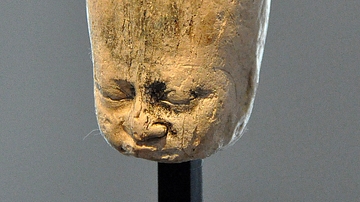
Pharaoh Khufu
Limestone head from a statuette of the Egyptian pharaoh Khufu (Kheops). From modern-day Egypt. Old Kingdom, 4th Dynasty, circa 2600 BCE. (State Museum of Egyptian Art, Munich, Germany).
