
Search
Remove Ads
Advertisement
Search Results

Article
Egyptian Afterlife - The Field of Reeds
The ancient Egyptians believed that life on earth was only one part of an eternal journey which ended, not in death, but in everlasting joy. When one's body failed, the soul did not die with it but continued on toward an afterlife where one...

Definition
Seshat
Seshat (also given as Sefkhet-Abwy and Seshet) is the Egyptian goddess of the written word. Her name literally means "female scribe" and she is regularly depicted as a woman wearing a leopard skin draped over her robe with a headdress of...

Definition
Second Intermediate Period of Egypt
The Second Intermediate Period (c. 1782 - c.1570 BCE) is the era following the Middle Kingdom of Egypt (2040-1782 BCE) and preceding the New Kingdom (1570-1069 BCE). As with all historical designations of the eras of Egyptian history, the...

Definition
Egyptian Book of the Dead
The Egyptian Book of the Dead is a collection of spells which enable the soul of the deceased to navigate the afterlife. The famous title was given the work by western scholars; the actual title would translate as The Book of Coming Forth...

Definition
Ancient Egyptian Mythology
Egyptian mythology was the belief structure and underlying form of ancient Egyptian culture from at least c. 4000 BCE (as evidenced by burial practices and tomb paintings) to 30 BCE with the death of Cleopatra VII, the last ruler of the Ptolemaic...

Definition
Egyptian Obelisk
An obelisk is a stone rectangular pillar with a tapered top forming a pyramidion, set on a base, erected to commemorate an individual or event and honor the gods. The ancient Egyptians created the form at some point in the Early Dynastic...

Definition
Ancient Egypt
Egypt is a country in North Africa, on the Mediterranean Sea, and is home to one of the oldest civilizations on earth. The name 'Egypt' comes from the Greek Aegyptos which was the Greek pronunciation of the ancient Egyptian name 'Hwt-Ka-Ptah'...
Article
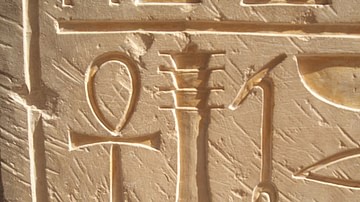
Ancient Egyptian Symbols
Religion in ancient Egypt was fully integrated into the people's daily lives. The gods were present at one's birth, throughout one's life, in the transition from earthly life to the eternal, and continued their care for the soul in the afterlife...
Image
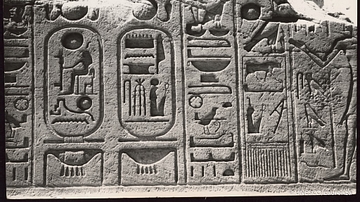
Hieroglyphics Detail, Abu Simbel
Great Temple (height: 110 feet / 33 meters, width: 127 feet / 38 meters) built under the XIXth Dynasty. On the facade four colossuses about 67 feet / 20 meters high represent Rameses II (1290-1223 BCE). The complete work is about 210 feet...

Article
The Egyptian Cinderella Story Debunked
The story of Cinderella is one of the most popular in the world. In the west, it has enjoyed a continuous following since its revision and publication by Charles Perrault in 1697 CE but the tale of the young heroine, unjustly forced into...
