
Search
Remove Ads
Advertisement
Search Results

Definition
The Negative Confession
The Negative Confession (also known as The Declaration of Innocence) is a list of 42 sins which the soul of the deceased can honestly say it has never committed when it stands in judgment in the afterlife. The soul would recite these in the...
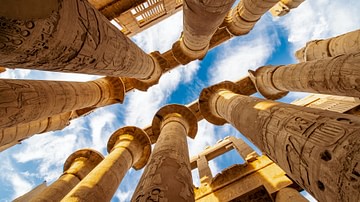
Image Gallery
A Gallery of Ancient Egyptian Temples
The temple in ancient Egypt was the home of the deity it was built for, and the clergy attended the statue of that god or goddess as they would a living person. Every temple was designed with a forecourt, a reception area for public gatherings...
Definition
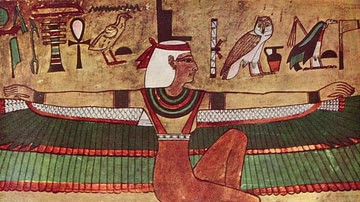
Isis
Isis is an ancient Egyptian goddess who became the most popular and enduring of all the Egyptian deities. Her name comes from the Egyptian Eset, ("the seat") which referred to her stability and also the throne of Egypt as she was considered...
Image Gallery
A Gallery of Ancient Egyptian Gods & Goddesses
The gods and goddesses of ancient Egypt were an integral aspect of the peoples’ daily lives, inhabiting not only the temples thought to be their homes but the streams, lakes, plains, and trees of the land and, of course, the Nile River. The...
Image Gallery
A Gallery of Ancient Egyptian Monarchs & Nobility
The monarchs and nobility were at the top of the social structure in ancient Egypt and were supposed to serve as role models for the rest of the people concerning the will of the gods and one’s proper response to their many blessings. The...
Collection
Ancient Egyptian Goddesses
Egyptian goddesses are among the best-known and most popular from antiquity. Images of Isis, Hathor, Bastet, and Selket – among many others – are world-famous. The popularity of these female deities reflects the high status of women in ancient...
Article
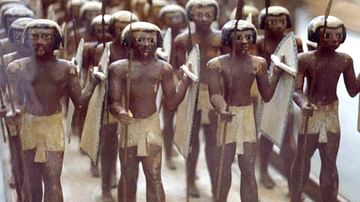
Weapons in Ancient Egypt
The ancient Egyptian military is often imagined in modern films and other media as a heavily armed and disciplined fighting force equipped with powerful weapons. This depiction, however, is only true of the Egyptian army of the New Kingdom...

Image
Egyptian Stela of Horemheb
Only this fragment from the top of a round topped limestone stela has survived. There are 3 columns of hieroglyphic inscriptions; these state that the stela was "made by the guardian of king's provisions of the Lord of the Two Lands Horemheb"...

Image
Egyptian Door Jamb
Limestone fragment of a door jamb from the temple of Seth (built by the Egyptian pharaoh Thutmose III) at Ombos (Naqada), Egypt, 18th Dynasty, 1543-1292 BCE. The Petrie Museum of Egyptian Archaeology, London (With thanks to The Petrie Museum...

Article
Death in Ancient Egypt
To the ancient Egyptians, death was not the end of life but only the beginning of the next phase in an individual's eternal journey. There was no word in ancient Egyptian which corresponds to the concept of "death" as usually defined, as...
